Arx: Civilization Upgraded. The Decentralized Blueprint for a Free Society.

Arx Revolution

Arx RevolutionArx RevolutionArx Revolution
Home
Arx as Incubator
About
FAQ
Defining the Revolution
Foundational Principles
Organization
Revitalizing Small Towns
Sociological Architecture
Humanoid Robots in Arx
Operational Framework
Genetic Concepts
Trait Amplification
Who Is Arx for?
Join Us
Why Lineage?
Privacy Policy

Arx Revolution

Arx RevolutionArx RevolutionArx Revolution
Home
Arx as Incubator
About
FAQ
Defining the Revolution
Foundational Principles
Organization
Revitalizing Small Towns
Sociological Architecture
Humanoid Robots in Arx
Operational Framework
Genetic Concepts
Trait Amplification
Who Is Arx for?
Join Us
Why Lineage?
Privacy Policy
More
  • Home
  • Arx as Incubator
  • About
  • FAQ
  • Defining the Revolution
  • Foundational Principles
  • Organization
  • Revitalizing Small Towns
  • Sociological Architecture
  • Humanoid Robots in Arx
  • Operational Framework
  • Genetic Concepts
  • Trait Amplification
  • Who Is Arx for?
  • Join Us
  • Why Lineage?
  • Privacy Policy

  • Home
  • Arx as Incubator
  • About
  • FAQ
  • Defining the Revolution
  • Foundational Principles
  • Organization
  • Revitalizing Small Towns
  • Sociological Architecture
  • Humanoid Robots in Arx
  • Operational Framework
  • Genetic Concepts
  • Trait Amplification
  • Who Is Arx for?
  • Join Us
  • Why Lineage?
  • Privacy Policy

Political Ideologies Incompatible With Directed Evolution

Contrast between conscious evolution and egalitarian universalism concepts.

Political Ideologies Incompatible With Directed Evolution

Conscious evolution at Arx is the intentional amplification of high-fitness ancestral lineages through sovereign, selective communities. It demands rigorous stewardship of co-adapted gene suites—cognitive acuity, physical robustness, objective beauty, emotional resilience, civilizational competence—and the Europoid phenotype forged by millennia of European selection pressures. This is neither sentimental humanitarianism nor blind, undirected drift. It is directed ascent: protecting, refining, and compounding what has already proven capable of building complex societies and reaching for the stars.

Modern egalitarian and universalist philosophies, many rooted in communist blank slate ideologies, stand in direct opposition. These doctrines deny innate human differences, obscure genetic realities, and treat mind and behavior as infinitely malleable products of environment and oppression. By flattening variance and demanding enforced sameness, they sabotage the selective pressures, boundary defense, and lineage stewardship required for conscious evolution. Many political philosophies clash with the Arx imperative because they prioritize leveling, openness, or redistribution over the realities of heritable variation, linkage disequilibrium in gene suites, and the necessity of selection. They treat human differences as malleable social constructs to be equalized rather than adaptive legacies to be protected and compounded. Below we outline key incompatibilities.


The political concepts most at odds with Arx’s vision are those that:

(1) deny variation in human traits,

(2) suppress selection and differentiation,

(3) treat all outcomes as interchangeable,

(4) undermine long-horizon stewardship, or

(5) dissolve coherent cultural and phenotypic norms.


Core Incompatibilities

Biological Egalitarianism (Denial of Human Biodiversity) and the Myth of Interchangeability 

Equality-of-outcome doctrines assume humans (or lineages) are fundamentally equivalent and that observed differences stem primarily from injustice rather than heritable suites of traits. This directly undermines conscious evolution. Genes do not operate in isolation; they arrive in linked complexes shaped by deep ancestral selection. Denying variance or demanding uniform results erodes the very substrate of ascent—preventing the amplification of high-fitness clusters while subsidizing lower-fitness ones. Arx rejects any premise that all lineages are equally positioned for interstellar viability or civilizational complexity. Arx rejects the insistence that all human populations, groups, and individuals possess identical distributions of cognitive, behavioral, and physical potentials (the gross misinterpretation of "all men are created equal."). Conscious evolution treats observable genetic disparities as the essential raw material for deliberate improvement. Denying these differences prevents any targeted advancement.


Short-Term Majoritarianism and Postmodern Relativism

Democracies tuned to median voter preferences or lowest-common-denominator appeals favor immediate consumption over long-horizon genetic and cultural compounding. Relativism denies objective measures of fitness, treating all values and outcomes as equal. Both erode the epistocratic, antifragile governance Arxes require.


Meritocracy Misapplied

While Arx employs rigorous, results-oriented selection, pure individualism in meritocracy can overlook that merit itself emerges from co-evolved gene suites and cultural lineages, not atomized achievement alone. Selection must honor holistic compatibility, ancestral continuity, and phenotypic alignment (including the Europoid form shaped by millennia of European selection pressures) rather than abstract scoring that ignores linkage and group-level adaptation. Our closed-loop systems prioritize lineage-level fidelity over open-market individualism.


Dysgenic Welfare Policies

Modern welfare states reverse natural selection by decoupling reproductive success from capability. Subsidizing reproduction among lower-capability strata while burdening high-capability lineages drives population-level declines in intelligence, health, and resilience. Unconditional redistribution detaches resources from fitness and contribution. Anti-natalist or degrowth pressures applied to high-capacity lineages actively reverse ascent. Grievance-based politics reframes outcomes as oppression rather than outcomes of heritable traits and agency, discouraging the rigorous self-accountability required for stewardship. These approaches accelerate dysgenic trends that conscious evolution must counteract.


Equity and Engineered Sameness

Equity demands forced equalization of outcomes through lowered standards, redistribution, and artificial representation. This misallocates resources away from excellence and directly contradicts selective amplification of superior trait clusters. It misallocates resources away from excellence toward remediation, diluting the selective pressures that conscious evolution must intensify. In an Arx, resources and reproduction favor demonstrated contribution and heritable potential—not engineered parity. 


Undifferentiated Diversity, Inclusion, and Openness

Blanket celebration of demographic heterogeneity and unconditional inclusion, regardless of compatibility or fitness costs. This introduces entropy, dilutes adaptive gene suites, and erodes high-trust boundaries. Arx requires absolute control over composition and maintains fidelity to the Europoid phenotype and its associated adaptations. Undesirable diversity—genetic, cultural, or phenotypic dilution—introduces entropy into high-trust, closed-loop systems. Inclusion as a moral absolute demands accommodation of incompatible elements, eroding boundaries essential for lineage continuity. Arx maintains absolute control over composition precisely because evolution favors curation, not homogenization or external demographic pressures. We favor the Europoid phenotype and the specific adaptive suites it carries; this is not prejudice but fidelity to what has demonstrably built the technological and institutional foundations for further ascent.


Anti-Discrimination as Categorical Prohibition

Blanket anti-discrimination mandates—treating any recognition of group or individual differences in heritable traits as moral or legal wrongdoing—directly contradict the foundational mechanism of evolution. Biological evolution is discrimination: the non-random differential survival and reproductive success of individuals and lineages based on adaptive traits. Without discrimination (selection pressures acting on variance in cognitive acuity, behavioral restraint, physical robustness, disease resistance, and civilizational competence), there can be no directed ascent, only entropic drift toward the mean or regression to lower fitness. Enforced anti-discrimination flattens these pressures by demanding uniform treatment regardless of compatibility, genetic load, or proven contribution. It transforms voluntary, high-resolution curation of gene-culture complexes into a prohibited act, subsidizing maladaptive traits while penalizing the stewardship of high-fitness clusters. At Arx, we openly acknowledge protected classes under prevailing law at the systemic/network level while asserting full sovereignty within habitats to discriminate rigorously on merit, alignment, ancestry, and phenotype. This is not animus but fidelity to evolutionary reality: selection requires the right to say “no” to lower-fitness inputs. Philosophies that weaponize anti-discrimination as a universal moral absolute render conscious evolution impossible by criminalizing the very discrimination that built European-descended excellence over millennia. True progress demands the freedom to discriminate in favor of what works.


Medical Over-Interventionism and Genetic Load Accumulation

Advanced medicine that enables reproduction of individuals with severe heritable disorders—without parallel genetic screening or editing—circumvents natural selection and rapidly increases deleterious mutation load.


Technocratic Pathologization of Genius

Bureaucratic systems that medicate, suppress, or “normalize” extreme behavioral outliers and unconventional neurotypes. Evolutionary leaps frequently depend on these eccentric, hyper-focused individuals; pathologizing them undermines the variation needed for ascent.


Cosmopolitan Universalism, Anti-Tribalism, and Anti-Border Pressures

The ideal of dissolving humanity into a single, borderless, monocultural populace. Conscious evolution requires distinct, semi-isolated “laboratory” populations experimenting with different genetic, cultural, and social configurations. The notion of a single global human family with equal claims on every sovereign project ignores kin selection, group differences, and the realities of trust and reciprocity. Conscious evolution operates through particularist stewardship—focused amplification within aligned peerages—not diffuse obligations to all of humanity. Universalist integration dissolves the high-resolution selection environments required for multi-generational optimization.


Shifting Baseline Syndrome via Affirmative Action

The systematic lowering of institutional, academic, and professional standards for demographic representation. This replaces objective selection for competence with politicized metrics, eroding the merit mechanisms conscious evolution must intensify.


Postmodern Relativism and Anti-Objectivism

The claim that truth, capability, beauty, and advancement are merely subjective social constructs. Conscious evolution is teleological—it requires objective metrics of “better”: higher intelligence, greater resilience, objective beauty, optimized health, and civilizational competence.


Biophobia and Anti-Transhumanist Legislation

Political or religious resistance to Artificial Reproductive Technologies (ART), genetic engineering, CRISPR, cognitive enhancement, and other tools of directed biology. Such barriers block humanity’s ability to consciously steer its own evolutionary future.


Neo-Malthusian Environmentalism and Degrowth Politics

Advocacy for Europoid population reduction (anti-natalism), industrial rollback, and technological contraction. Conscious evolution demands aggressive expansion of energy capture, technological capacity, and off-planet presence. Evolution is a numbers game. The more Europoids that are born, the higher the probabilities of advantageous allelic combinations. Degrowth is an evolutionary dead end.


Therapeutic Culture of Victimhood

A societal reward system that elevates fragility, trauma, and vulnerability over strength, adaptability, and fortitude. Conscious evolution requires high-agency, resilient mindsets capable of rigorous multi-generational stewardship.


Additional Structural Conflicts

•  Radical individualism and atomization that sever obligations to lineage and descendants.

•  Anti-hierarchy absolutism that rejects even competence-based differentiation.

•  Anti-natalism and anti-family frameworks that discourage reproduction among fit Europoids.

•  Cultural relativism that treats all norms as equally adaptive (culture enforces genes and genes enforce culture in a loop). Cultural disruption alters environmental genetic selection pressures.

•  Short-term political myopia that prioritizes immediate gratification (high time preference behavior) over long-horizon compounding (low time preference behavior).


At Arx we embrace particularism, hierarchy, boundary defense, phenotypic fidelity, and voluntary eugenic stewardship — not as ideology, but as alignment with evolutionary reality. Philosophies that obscure genetic truths, flatten human biodiversity, subsidize the unfit, or dissolve coherent lineages do not merely differ from us; they constitute active opposition to the next phase of human potential.

Arx exists as a sovereign countermeasure: fortified habitats where fit Europoid-descended lineages compound unapologetically, without egalitarian entropy or external veto.


This is conscious evolution. All else is delusion and decline.

Biological Realities

Biological Realities

Arx is built on the recognition that biological differences are real, measurable, and consequential. Sex differences in physiology, temperament, cognitive architecture, and reproductive strategy are not social constructs but evolved adaptations with profound downstream effects on behavior, capability, and group performance. Allelic variation—across populations and individuals—produces real differences in IQ distribution, impulse control, stress response, spatial reasoning, verbal fluency, risk tolerance, and resilience under pressure. These are not trivial or interchangeable traits; they shape outcomes at the individual, familial, and civilizational level.

The phrase “all men are created equal” originally referred to equal standing under law for free, property-owning men in a specific political context. It has since been distorted into a claim of literal biological equivalence, which is demonstrably false. 

Sex chromosomes (XX vs. XY) and autosomal allelic differences generate non-trivial variance in nearly every trait relevant to survival, reproduction, and cultural transmission. Denying or suppressing this reality does not erase it; it merely handicaps those who refuse to see clearly.

Conscious evolution in the Arx ecosystem begins with this premise: excellence is heritable, differential, and selectable. Arx does not pretend all lineages are interchangeable or that every individual carries equivalent adaptive potential. Instead, it creates deliberate, high-trust environments where proven traits—cognitive acuity, emotional stability, physical robustness, moral coherence, and civilizational competence—are actively amplified across generations. This is not universal egalitarianism; it is voluntary, meritocratic stewardship of what has already demonstrated fitness.

The project rejects both naive blank-slate ideology and passive genetic fatalism. Biological realities are not destiny—they are the raw material. Arx applies intentional selection, structured child-rearing, closed-loop autonomy, and cryptographic governance to compound adaptive excellence rather than allow it to drift or dilute. The result is a multigenerational endeavor that honors the chain of ancestry by refusing to be a weak link, and secures the future by engineering lineages capable of enduring and ascending.

Voluntary Duty to Ancestors and Future Generations

Voluntary Duty to Ancestors and Future Generations

Arx is founded on the recognition that every individual exists as a living link in an unbroken chain of ancestry and descent. Our actions reverberate backward and forward through time: what we do strengthens or weakens the continuity of the lineage that preceded us and the potential of the lineage that will follow. This is not a mystical assertion but a practical reality—genetic, cultural, and civilizational traits are transmitted across generations, and each generation bears responsibility for the integrity of that transmission.

We are not the endpoint of evolution, nor are we isolated actors. We inherit the cumulative adaptations, achievements, and sacrifices of thousands of forebears. In turn, our choices determine whether those gains endure or erode. To fail in stewardship is to become a weak link that severs the chain, diminishing not only the future but the meaning of the past. The ancestors who survived famine, war, disease, and hardship did so that their descendants might live with greater capacity. To squander that legacy is to dishonor their struggle.

Conversely, to act with deliberate intention is to honor both those who came before and those who will come after. This is a voluntary duty, not a universal obligation. Arx is for those who feel the weight of this connection and choose to carry it forward. It is expressed through the multigenerational architecture of every Arx arcology, the distributed resilience of the Arx Global Network, and the unifying coherence of the Arx Federation. The project is not about immediate personal gain but about planting trees under whose shade future generations will rest—trees whose roots draw strength from the soil of ancestral accomplishment.

In Arx, this duty is neither sentimental nor imposed. It is a rational commitment to continuity: to preserve and amplify what has proven adaptive, to reject dilution and entropy, and to build environments where excellence compounds across centuries rather than dissipating within one. Those who accept this calling do so freely, knowing that the chain is only as strong as each link chooses to make it.

Agrarian Virtues and the Wholesome Countryside Ideal

Resilient arcologies for sovereign human ascent

The agrarian tradition recognizes that those who actively cultivate the land and steward natural systems build essential foundations for a stable, flourishing society. Direct engagement with soil, seasons, and self-reliant production fosters character, practical wisdom, clear judgment, and a grounded perspective that supports long-term thinking and personal responsibility. This way of life generates real value through productive effort and cultivates resilience, foresight, and a deep appreciation for natural cycles—qualities often more reliable than those shaped primarily by commerce, finance, or high-density urban routines.

This view contrasts rural and small-scale living with the dynamics of large, dense cities. Overly concentrated urban environments can foster anonymity, dependency, fleeting trends, and social fragmentation, making individuals more susceptible to external influences and short-term pressures. When people live removed from productive land and natural rhythms, it becomes easier for detachment, luxury-driven idleness, and collective vulnerabilities to emerge.


Why a Balanced Perspective on Countryside Strengths and Urban Challenges?

This outlook draws from enduring patterns:

•  Self-Sufficiency and Autonomy: Working and stewarding one’s own land or productive systems builds physical capability, practical skills, and a direct investment in property, resources, and limited external control. In contrast, heavy reliance on wages, markets, or centralized systems can reduce personal independence.

•  Moral and Personal Formation Through Nature and Labor: Interaction with the land instills patience, humility, foresight, and connection to natural processes. Productive, grounded work tends to reinforce accountability and virtue, while environments detached from these can erode them through overcrowding, abstraction from creation, or overemphasis on consumption.

•  Civic Stability and Long-Term Thinking: Rooted producers with skin in the game often prioritize community stewardship, generational continuity, and pragmatic governance. Dense populations can lean toward immediate concerns, factionalism, and responsiveness to transient influences. Societies with widespread access to productive land and resources tend to sustain stability more effectively.

•  Health, Resilience, and Anti-Fragility: Rural or semi-rural settings promote physical and mental robustness through active lifestyles and lower concentrations of certain risks. Large cities can amplify disease transmission, systemic dependencies, and fragility during disruptions.

These observations appear across classical thought, Enlightenment ideas, Romantic traditions, and modern critiques of industrial-scale living. They highlight timeless human preferences for environments aligned with our evolved needs.


Relevance to the Arx Vision

Arx does not advocate retreating to isolated traditional farmsteads. Instead, it offers a modern synthesis: resilient arcologies—intentional, sovereign habitats that blend the best of agrarian virtues with advanced capabilities. These multistory, ecologically integrated designs emphasize nature woven into architecture and surroundings—green spaces, living systems, and harmonious landscapes—while providing select efficiencies and conveniences of organized living, such as shared high-trust infrastructure, without the drawbacks of sprawling megacities.

Our foundries prioritize:

•  Productive and Stewardship Virtues — Closed-loop systems for food, energy, water, and essentials, enhanced by biotechnology, automation, and ecological design. This maintains meaningful connection to labor and natural processes in a sustainable, high-efficiency framework.

•  Localism and Sovereignty — Merit-based, high-trust communities with aligned peerages maintain control over membership and direction. This supports strong local cultures and economies alongside strategic networks, protected from external dilution.

•  Intergenerational Ascent — Norms emphasizing cultural synthesis, ancestral wisdom, and deliberate trait cultivation compound excellence across generations. Arcologies enable this at scale through intentional design, far beyond scattered individual efforts.

•  Resilience Over Fragility — Arxes create defensible, adaptive environments tuned to human nature—integrating nature, autonomy, and community—rather than anonymity or over-dependency.


The agrarian tradition highlights that thriving societies ground themselves in ways of life that reward fitness, virtue, foresight, and stewardship. Arx advances this intentionally through engineered habitats: not nostalgia for the past, but forward-looking arcologies where aligned lineages cultivate independence, excellence, and long-horizon resilience—while safeguarding against erosive influences. This creates a healthy blend: rooted productivity and natural integration alongside modern technological mastery and selective communal benefits.

foundational principles: The science behind arx

The Science Behind Arx

Arx is engineered from first principles: a deep understanding of the psychological, neurobiological, and social mechanisms that govern human motivation, attachment, well-being, and long-term group performance. The model is not arbitrary; it is deliberately structured to satisfy the most fundamental human drives while creating the conditions for generational ascent.


Maslow’s Hierarchy of Needs

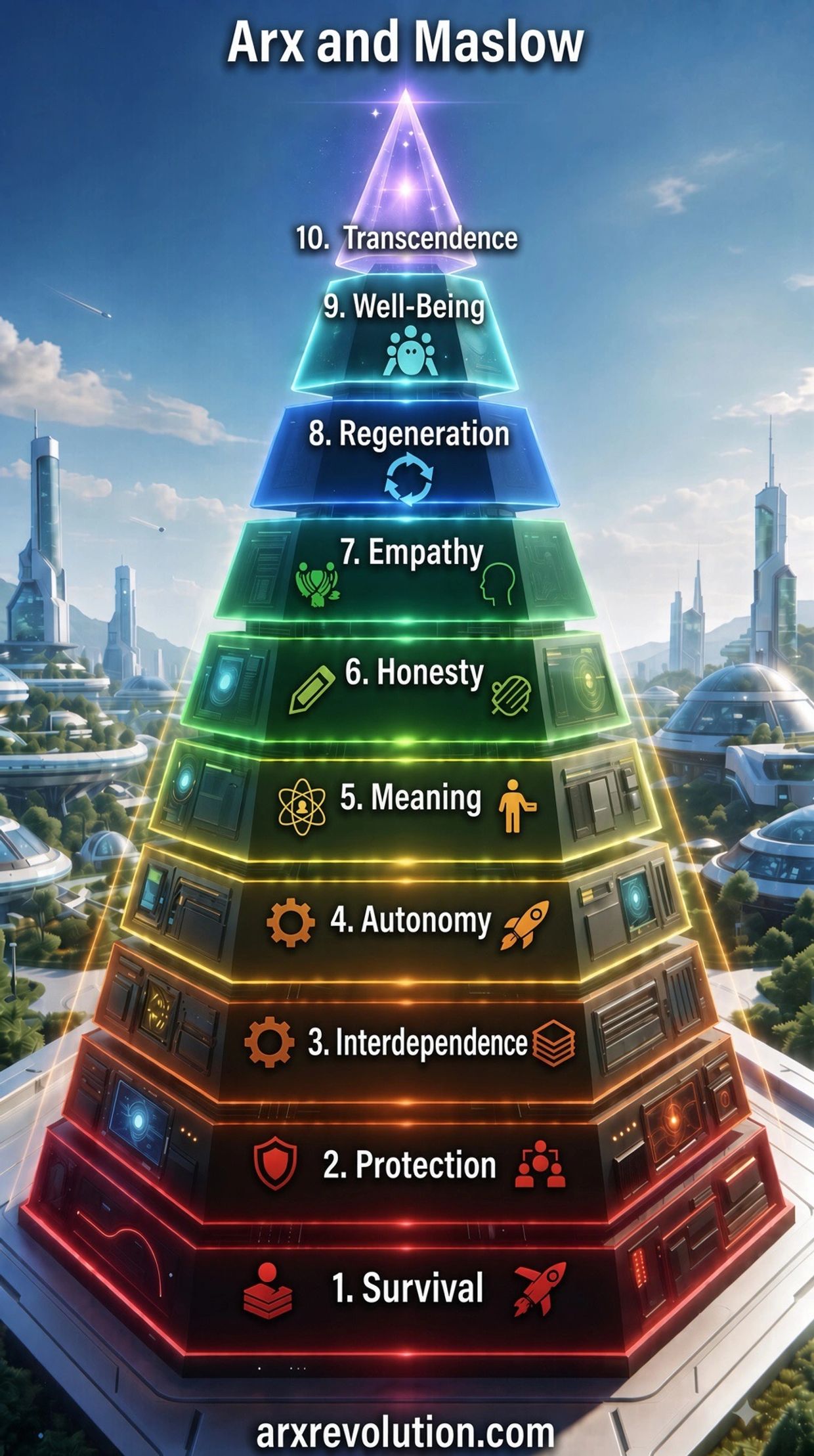
Arx systematically fulfills Maslow’s hierarchy at every level, far beyond what the outside world typically provides. Physiological and safety needs are met through closed-loop autonomy (energy, food, water, security). Belonging and esteem are satisfied through high-trust, merit-based communities where contribution directly determines status and recognition. Self-actualization and transcendence are achieved through purposeful lineage stewardship and the shared mission of civilizational endurance. By removing scarcity and uncertainty, Arx frees cognitive and emotional energy for higher-order pursuits.


Erikson’s Psychosocial Stages

Erikson’s developmental model highlights the importance of trust, autonomy, initiative, industry, identity, intimacy, generativity, and integrity across the lifespan. Arx communities are designed to support every stage:

•  Early trust and autonomy through structured, high-caliber child-rearing.

•  Industry and identity through meritocratic feedback and purposeful roles.

•  Intimacy and generativity through high-trust relationships and intentional reproduction.

•  Integrity in later life through continued contribution as pod mentors and the knowledge that one’s lineage is being amplified.


Neuroscience of Trust and Bonding

Oxytocin and vasopressin pathways are actively reinforced through frequent positive social interactions, shared meals, cooperative child-rearing, and ceremonial bonding events (low-dose empathogens used sparingly and consensually). These neurochemical mechanisms create powerful in-group attachment and trust, reducing stress (cortisol) and increasing resilience. BDNF and neuroplasticity are supported through immersive education and challenging tasks, fostering lifelong learning and adaptation.


Science of Kindness

The neuroscience of kindness—oxytocin-mediated empathy and prosocial behavior—is cultivated through structured practices: mutual accountability, shared purpose, and visible acts of contribution. Kindness is not sentimental; it is strategic. High-trust environments reduce conflict and increase cooperation, creating a feedback loop where empathy strengthens group performance and lineage success.


Industrial-Organizational Psychology

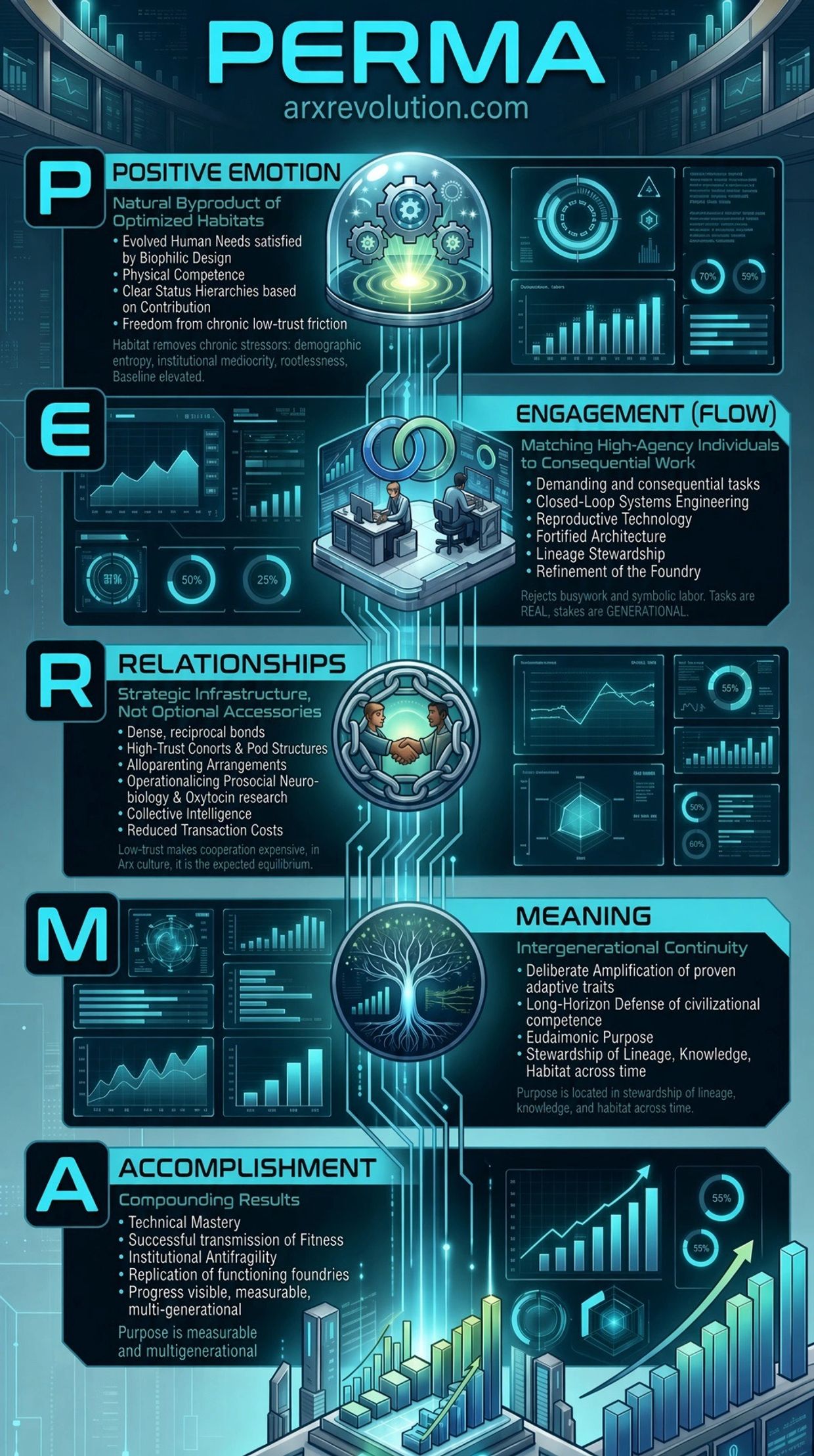
Arx applies principles of high-performance team design: clear roles, meritocratic rewards, psychological safety within boundaries, and alignment on mission. Contribution is measured and visible, eliminating resentment and free-riding. The system uses goal-setting theory (Locke & Latham) and expectancy theory (Vroom) to tie effort to outcomes—credits, status, and reproductive priority—ensuring sustained motivation.


The Voluntary Duty to Future Generations

The ethical core is simple: those with exceptional traits have a voluntary duty to future generations to ensure these traits are not merely preserved but amplified. This duty is not universal or imposed; it is a self-selected commitment within sovereign communities. Arx does not denigrate non-participants or claim moral superiority over the wider world. It simply creates the conditions for those who feel this responsibility to act on it—through private, consensual means—without apology or external obligation.


These foundations—Maslow, Erikson, neuroscience, kindness, and organizational psychology—are not abstract theory. They are the scientific rationale for why Arx is structured the way it is: a high-trust, meritocratic system that fulfills fundamental human needs while enabling deliberate lineage strengthening. The result is an environment that is not only desirable but psychologically and biologically rewarding, making participation a rational and fulfilling choice for aligned individuals.

How Arx Uses Maslow’s Hierarchy of Needs

Arx communities are deliberately structured to fulfill Maslow’s hierarchy of needs at every level, creating an environment where physiological and safety requirements are met so reliably that participants can consistently pursue higher-order goals of belonging, esteem, self-actualization, and transcendence. At the base, physiological needs—nutrition, sleep, temperature regulation, and physical health—are addressed through closed-loop autonomy that guarantees abundant, nutrient-dense food, clean water, optimal rest environments, and comprehensive medical care. Safety needs are satisfied by fortified boundaries, cryptographic governance, and strict merit-based protocols that eliminate external threats, scarcity anxiety, and uncertainty, allowing residents to operate in a state of low chronic stress and high cognitive clarity.

Once these foundational layers are secured, Arx systematically cultivates belonging and esteem through high-trust, meritocratic social architecture. Belonging emerges from frequent positive interactions, shared purpose (lineage amplification), and overlapping roles in child-rearing, governance, and daily life, reinforced by neurobiological mechanisms such as oxytocin release during cooperative tasks and communal rituals. Esteem is achieved through transparent contribution metrics—credit points, visible outcomes, and merit-weighted influence—that provide constant, objective feedback on individual value and standing. This structure satisfies the need for respect, recognition, and mastery without relying on external validation or superficial status markers.

At the apex, Arx supports self-actualization and transcendence by embedding residents in a multi-generational project of civilizational endurance. Self-actualization is realized through purposeful stewardship—deliberately amplifying adaptive traits and contributing to cohort success—while transcendence arises from the shared mission of extending proven lineages beyond Earth. By removing the barriers that prevent most people from reaching these higher levels in conventional society, Arx enables participants to live in a state of sustained fulfillment, where the pursuit of excellence and legacy becomes the natural expression of human potential rather than an exceptional achievement. This application of Maslow’s framework is not incidental; it is the intentional design principle that makes Arx communities not only viable but profoundly rewarding.

Arx and the Science of Kindness

The science of kindness—rooted in the neurobiology of prosocial behavior, empathy, and compassion—demonstrates that deliberate acts of generosity and care produce measurable physiological and psychological benefits for both giver and receiver. Oxytocin release during prosocial interactions strengthens trust and attachment, reduces cortisol levels, activates reward circuitry via dopamine pathways, and enhances vagal tone, contributing to improved emotional regulation, social cohesion, and resilience. These mechanisms are not incidental; they form the biological substrate for high-trust groups capable of sustained cooperation and collective performance. Arx integrates this science as a core design principle, creating environments where kindness is systematically reinforced rather than left to chance.

In Arx communities, kindness operates as strategic social glue. Frequent positive interactions—shared meals, cooperative child-rearing, mutual accountability, and visible acts of contribution—trigger endogenous oxytocin and vasopressin release, fostering secure attachment and in-group loyalty without coercion. The meritocratic structure ensures that kindness is reciprocated and rewarded: prosocial behavior directly increases merit, governance influence, and reproductive priority, aligning individual incentives with group flourishing. This creates a feedback loop where empathy and generosity become self-reinforcing norms, reducing conflict and elevating collective output.

The ethical implication is deliberate: Arx views kindness not as sentimental charity but as an adaptive trait that has historically enabled group survival and excellence. By cultivating it within high-trust boundaries, Arx amplifies the very mechanisms that allow exceptional lineages to thrive. Participants experience the neurobiological rewards of prosociality—elevated mood, reduced stress, deeper belonging—while contributing to multi-generational outcomes. The result is a community where kindness is both felt and functional, supporting the project’s commitment to sovereign, voluntary lineage strengthening. Arx does not impose kindness universally; it provides the conditions for those who value it to practice it at scale, with compounding benefits for individuals, families, and the broader movement.

Copyright © 2026 Arx Revolution - All Rights Reserved.

Powered by

  • Privacy Policy

This website uses cookies.

We use cookies to analyze website traffic and optimize your website experience. By accepting our use of cookies, your data will be aggregated with all other user data.

DeclineAccept