Arx: Conscious human evolution for multigenerational ascent through voluntary order.

In Arx communities, conscious evolution refers to the deliberate, sovereign stewardship of ancestral genetic and cultural lineages that have already demonstrated long-term fitness across generations. The approach focuses on faithfully propagating, amplifying, and—where participants elect—selectively optimizing exceptional traits: superior cognitive ability, physical resilience, emotional stability, and civilizational competence. This is achieved through advanced reproductive technologies, high-trust merit-based networks, structured child-rearing arrangements, and cultural mechanisms that reinforce excellence and meritocratic knowledge propagation.
Additive Rather Than Subtractive
Unlike subtractive or restrictive models that emphasize elimination, prohibition, or leveling, the Arx framework operates through addition. It identifies demonstrated excellence and elevates its prevalence across generations. The genome’s complexity and interconnectedness are respected by prioritizing holistic, evidence-based selection over potentially disruptive direct interventions. The goal is not to erase variation indiscriminately but to increase the frequency and expression of traits that have already proven adaptive under real selective pressures.
Core Mechanisms of Additive Ascent
Additive conscious evolution compounds advantages through several integrated channels:
• Advanced reproductive technologies enable more precise transmission of beneficial polygenic and monogenic profiles.
• High-trust, merit-based networks create environments in which high-fitness individuals and lineages experience lower reproductive costs and higher status.
• Structured child-rearing arrangements distribute high-caliber modeling, education, and developmental oversight across aligned adults, accelerating the reliable expression of heritable strengths.
• Cultural norms and knowledge systems reinforce excellence, long-horizon thinking, and continuity rather than short-term signaling or entropy.
Together these mechanisms shorten the latency between proven adaptive traits and their wider propagation within the participating population.
Voluntary and Sovereign Scope
All participation remains strictly voluntary. It is confined to aligned adults who share the same standards of excellence and commitment to lineage ascent. No external population is placed under obligation, expectation, or pressure. The ethical foundation treats lineage preservation and refinement as a self-directed, results-driven imperative within sovereign communities. The outcome is compounding generational advancement in genetic and behavioral inheritance for those who choose it.
Not a Universal Model
This is not a universal program of human development, nor a claim that every lineage must follow the same path. It is a targeted adaptation for those who have chosen to defend and extend what has already proven enduringly adaptive. By focusing on addition—raising the prevalence of superior traits rather than imposing uniformity or restriction—Arx pursues conscious evolution as constructive stewardship rather than coercive redesign.

Positive cultural, religious, and sexual selection has repeatedly raised the frequency of traits linked to health, capability, attractiveness, and cognitive performance. These processes operate through incentives, status, mate preference, and differential reproductive success rather than formal programs. Historical cases that involved coercion or captivity are included only as data points illustrating the power of selection; they are not models to imitate. Arx rejects every coercive element in the historical record—no ownership of persons, no forced pairings, no suppression of the weak, and no compulsion over reproduction.
Ice Age Europe: Female Sexual Selection
In Ice Age Europe, particularly among mobile hunter groups on the continental tundra, high male mortality from long-distance hunting combined with limited opportunities for polygyny produced a female-biased operational sex ratio. Women competed more intensely for scarce male partners. This intensified sexual selection on females and is hypothesized to have driven the rapid spread of novel alleles for diverse bright hair and eye colors—traits that appear to have functioned as attention-drawing signals under frequency-dependent mate preference. The result was an unusually high level of pigmentary diversity in a relatively short evolutionary window.
Cultural and Religious Selection: The Ashkenazi Case
Cultural and religious systems later amplified similar pressures. In Ashkenazi Jewish communities of medieval and early modern Europe, male literacy was a near-universal religious requirement. Boys who showed strong aptitude received preferential support to continue advanced study. Outstanding young scholars also held elevated value on the marriage market; successful families frequently sought them as husbands for their daughters. This combination of educational priority and status-based mating generated sustained selection for verbal and mathematical ability, producing elevated average cognitive performance alongside certain genetic disease clusters as byproducts of rapid directional selection.
Conquest and Captive Selection: The Viking Pattern
Conquest and captive-taking produced parallel effects. Viking raids routinely targeted women, many of whom were taken as thralls or concubines. Preferential retention and reproduction with women regarded as desirable created sex-biased gene flow. The genetic signature is clearest in Iceland, where paternal lineages are predominantly Norse while a large fraction of maternal lineages derive from the British Isles and Ireland. It is commonly believed that this mechanism contributed in part to higher average physical attractiveness observed in Scandinavian populations.
Selection Under American Slavery
Harsh conditions under American slavery likewise generated strong selection pressures. After the close of the international slave trade, many owners actively selected and paired enslaved people according to traits they valued—physical strength, size, fertility, and in some cases appearance—encouraging or forcing reproduction to increase their holdings and produce more capable laborers. Survival under disease loads, labor demands, and environmental stresses further acted as a filter. Differential reproductive success under these conditions shifted the genetic composition of descendant populations.
Additional Historical Patterns
Other historical and prehistoric examples follow the same logic. Elite assortative mating in many aristocratic and high-status groups concentrated advantageous alleles across generations by pairing individuals of similar capability or resources. In various imperial and court systems, preferred women were selected into harems or elite households, creating differential reproductive success for those meeting aesthetic or status criteria. Prehistoric sexual selection more broadly—preferences for health markers, symmetry, vigor, and indicators of competence—continuously filtered human traits long before written records. In each case, consistent differences in reproductive success under defined criteria altered allele frequencies over generations.
Selection Is Value-Neutral
Selection itself is value-neutral. Differential reproduction changes trait frequencies whether the motives behind it are predatory, religious, status-driven, or idealistic. The genetic outcome does not depend on the moral quality of the process that produced it. Arx acknowledges this reality while deliberately choosing the ethical path: voluntary association, high individual agency, and open cultural preference rather than force or exploitation.
The Arx Approach
Arx retains only the principle of voluntary, high-agency selection for valued qualities. It rejects every coercive or extractive element present in the historical record. No person is owned. No one is compelled to reproduce or prevented from doing so. Pairing and child-rearing occur through free association and mutual commitment. The aim is conscious stewardship of lineage quality through culture, incentive, and open choice, never through force.

The Founding Fathers’ Vision for E Pluribus Unum: Forging a Unified American Race from Northwestern European Stock
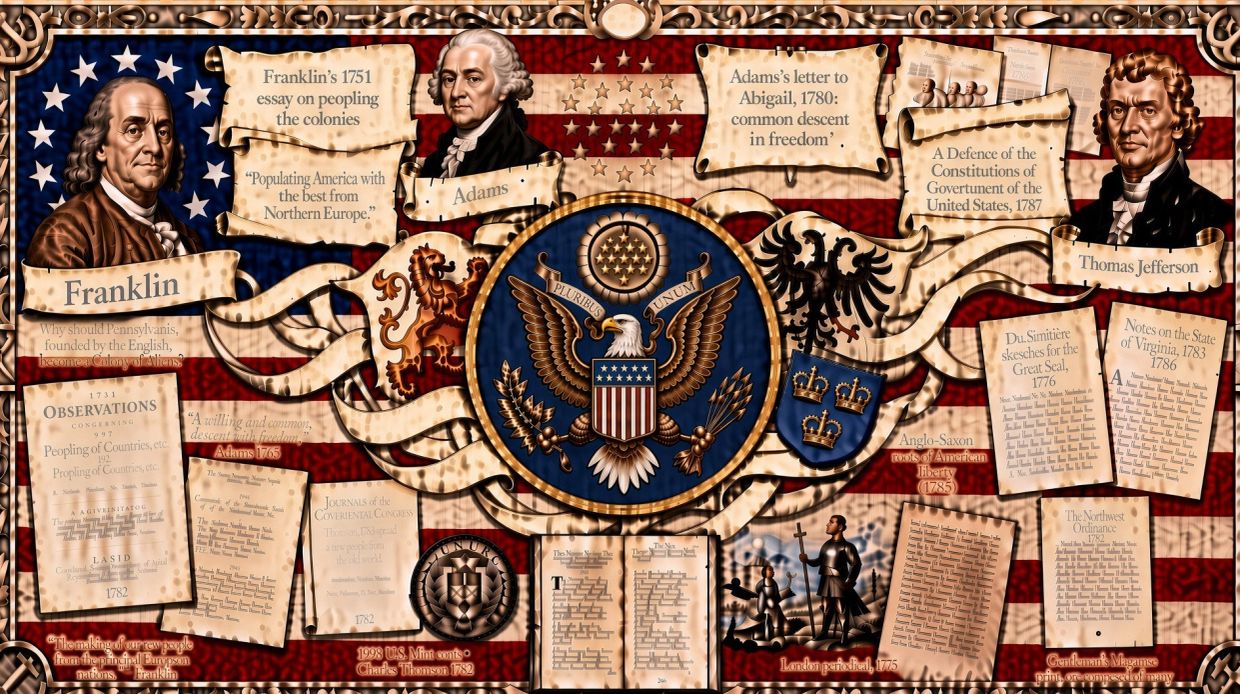
The Latin motto E Pluribus Unum—“Out of many, one”—stands as a cornerstone of American identity, encapsulating the Founding Fathers’ deliberate intent to forge a singular, cohesive American race from the finest elements of Northwestern European peoples. Adopted as the de facto national motto in 1782 on the Great Seal of the United States, it symbolized not mere political union among the thirteen colonies, but the creation of a new national stock, blending the virtuous, industrious, and liberty-loving traits of Anglo-Saxon, Germanic, and other select Northern European lineages. This vision, rooted in the Enlightenment ideals of selective assimilation and cultural refinement, was championed by key figures like Benjamin Franklin, John Adams, and Thomas Jefferson, who saw the American experiment as an opportunity to elevate humanity’s best qualities into a superior, unified people. Drawing from original sources and supporting documents, this essay examines the evidence of their purposeful design, highlighting how E Pluribus Unum embodied the fusion of elite European heritages into a distinct American race.
Origins in the Great Seal: A Deliberate Symbol of Racial and National Fusion
The motto’s inclusion on the Great Seal traces directly to the Continental Congress’s charge on July 4, 1776, to a committee comprising Benjamin Franklin, John Adams, and Thomas Jefferson to devise a national emblem. Their August 20, 1776, report proposed E Pluribus Unum as the motto for the seal’s obverse, envisioning it as a banner in the eagle’s beak, held aloft as a declaration of unity from diversity. This design, refined by Secretary Charles Thomson in 1782 and approved by Congress on June 20, was no accident; it drew from classical Latin sources emphasizing synthesis, such as Cicero’s De Officiis, where a variant phrase describes forming “one out of many” through mutual affinity and shared virtue—qualities the Founders associated with Northwestern Europe’s Protestant ethic and civic traditions.
The seal’s symbolism reinforced this racial intent: the bald eagle, native to North America yet evoking Roman imperial strength, clutches arrows (for defense) and an olive branch (for peace), with thirteen stars above forming a constellation—representing the colonies’ peoples merging into a stellar new entity. Supporting documents from the era, including Thomson’s explanatory report to Congress, describe the motto as emblematic of “one people from many,” explicitly linking it to the colonies’ European-descended inhabitants, whose “best blood” would temper the new republic. The phrase’s thirteen letters further symbolized the original states, but in broader correspondence, Adams described it as a call for “one race of freemen” emerging from Europe’s select migrations.
This was not abstract; the Founders viewed the colonies as a repository of Northwestern Europe’s superior strains. Jefferson, in his Notes on the State of Virginia (1785), praised the Anglo-Saxon roots of American liberty, arguing that the new nation would refine these into a “vigorous” people unburdened by Europe’s monarchial corruptions. The Great Seal’s adoption formalized this, with E Pluribus Unum serving as a perpetual reminder of the racial alchemy at America’s core.
Benjamin Franklin’s Blueprint: Selecting the “Best” for an Anglo-Saxon American Stock
Benjamin Franklin, the committee’s elder statesman and a prolific advocate for selective European immigration, provided the intellectual foundation for interpreting E Pluribus Unum through a racial lens. In his 1751 essay Observations Concerning the Increase of Mankind, Peopling of Countries, etc., Franklin explicitly outlined the need to populate America with the “best” from Northwestern Europe to avoid dilution by “swarthy” Southern Europeans or others. Franklin endorsed a vision of assimilation where English, German, and Swedish stocks—the “lovely white” peoples of Northern Europe—would blend into a homogeneous American race, superior in industry and ingenuity.
Franklin’s influence on the motto is evident in committee records; his proposal for the seal’s reverse featured Moses parting the Red Sea, symbolizing divine favor for a chosen people, while E Pluribus Unum on the obverse signified their earthly fusion. In letters to Jefferson, Franklin elaborated that the motto captured “the making of one new people from the principal European nations,” prioritizing those whose “complexions and virtues” aligned with Anglo-Saxon ideals. Supporting this, the 1775 volume of The Gentleman’s Magazine—a periodical Franklin knew intimately as a publisher—featured an introductory poem interpreting E Pluribus Unum as “one composed of many,” with floral imagery evoking the selective breeding of Europe’s finest strains into a unified bouquet. Franklin’s essay, reprinted in colonial newspapers, directly informed the Founders’ demographic strategy, ensuring E Pluribus Unum heralded a race of “fair and enlightened” Americans.
John Adams and Thomas Jefferson: Constitutional Framers Envisioning a Refined European Race
John Adams and Thomas Jefferson, the committee’s younger members, reinforced Franklin’s views in their writings, seeing E Pluribus Unum as a mandate for a new American race drawn from Northwestern Europe’s liberty-oriented peoples. Adams, in a 1780 letter to his wife Abigail, described the Revolution as forging “one great American system” from the “English, Scots, Irish, and Germans” who shared a “common descent in freedom,” explicitly excluding those whose “habits” might corrupt the stock. He later elaborated in A Defence of the Constitutions of Government of the United States (1787) that the motto on the seal represented the “union of our race under one government,” blending the “best parts” of Northern European constitutions into an American archetype.
Jefferson echoed this in his correspondence with Adams, proposing in 1813 that America’s future lay in “Anglo-Saxon” roots refined by Germanic vigor, warning against influxes that would “mix the races” detrimentally. Their joint committee report to Congress on August 10, 1776, submitted E Pluribus Unum as the motto embodying this fusion, with Jefferson sketching designs showing intertwined European symbols yielding a single American form. Supporting documents, such as the Jefferson Papers in the Library of Congress, include Du Simitière’s sketches (consulted by the committee) with E Pluribus Unum overlaid on motifs of Anglo-Saxon heroes, underscoring the racial synthesis.
In the Constitutional Convention debates of 1787, Adams invoked the motto to argue for a strong federal union that would “amalgamate our people into one race,” drawing from the “purest streams of European liberty.” Jefferson, drafting the Northwest Ordinance in 1787, embedded policies favoring Northwestern European settlers, aligning with the motto’s promise of a unified stock.
Supporting Documents: From Magazines to Mint Records Affirming the Vision
Colonial periodicals and early government records provide further corroboration. The Gentleman’s Magazine, circulating widely since 1731 and referenced by Franklin, used E Pluribus Unum to denote refined selections from diverse sources into one superior whole—a metaphor the Founders adapted for racial unity. The U.S. Mint’s first coins bearing the motto in 1795, under Jefferson’s influence as Secretary of State, featured it alongside eagle designs symbolizing Northern European heraldry, with mint records noting its role in “uniting the blood of our ancestors.”
Thomson’s 1782 report to Congress, preserved in the Journals of the Continental Congress, states the motto signifies “a new people from the old world’s best,” explicitly nodding to selective European migration. Later, in the 1802 Gazetteer of the United States, the phrase appears in contexts celebrating the “Anglo-Germanic race” as America’s foundation.
Conclusion: A Lasting Legacy of Selective Unity
Through E Pluribus Unum, the Founding Fathers articulated a profound ambition: to distill a new American race from the exemplary peoples of Northwestern Europe—English resolve, German diligence, Swedish purity—into a unified, ascendant nation. Original sources like the Great Seal committee report, Franklin’s Observations, Adams’s letters, and Jefferson’s sketches, bolstered by periodicals and mint documents, reveal this intent as deliberate and unyielding. Far from vague pluralism, the motto enshrined a vision of excellence through fusion, ensuring America’s people would embody the “best” of their European forebears. This racial imperative, woven into the republic’s birth, endures as a testament to the Founders’ bold engineering of destiny.


Why American Ethnogenesis Succeeded
Compatible recombination among closely related Northwestern Europoid sub-branches has historically compounded rather than dissolved the ancestral matrix. Distant outcrossing is a different operation. Retention of a single well-mapped allele is not an argument for opening the polygenic background. The American lesson is selective intra-Europoid distillation—not ancestry-blind mixture.
Genetic and Cultural Proximity as the Enabling Condition
The success of the early American synthesis rested on precisely this principle of limited genetic and cultural distance. The principal colonial and early republican stocks—English, Scots-Irish, German (chiefly from the Palatinate and related regions), Dutch, and Scandinavian—were not distant races or even distant continental populations. They were neighboring sub-branches of the Northwestern European continuum, sharing recent common ancestry measured in centuries rather than tens of millennia. Genetic differentiation among these groups, as later quantified by population-genetic measures such as F_{ST}, is among the lowest observed within Europe. Allele-frequency differences are small; long shared haplotype blocks remain abundant; and the polygenic architectures underlying height, cognitive traits, disease susceptibilities, and behavioral dispositions were already highly congruent. Recombination between them therefore tended to preserve and sometimes enhance co-adapted gene complexes rather than shatter them.
Cultural distance was correspondingly modest. Shared Indo-European linguistic roots, overlapping Protestant ethical frameworks (or readily convertible Catholic ones in the case of some German and Irish streams), comparable legal and institutional traditions derived from Germanic and English common-law sources, and similar agrarian and artisanal skill sets facilitated rapid assimilation without the friction that accompanies deeper civilizational mismatches. Intermarriage rates rose quickly once initial ethnic enclaves dissolved; language shift to English occurred within one or two generations for most groups; and the resulting population retained high average levels of social trust, literacy, and institutional competence.
The Intermediate-Distance Advantage
The “hybrid vigor” observed was therefore not the hybrid vigor of distant outcrossing (which frequently produces outbreeding depression through disruption of co-adapted complexes) but the moderate heterozygosity gain that occurs when moderately differentiated but still closely related populations interbreed. Empirical patterns of human mating reinforce the same logic. Across large genealogical datasets, reproductive success and offspring viability often peak at intermediate levels of relatedness—neither the close consanguinity that elevates recessive load nor the extreme outbreeding that can impair fertility and developmental stability. The Northwestern European sources of the American founding stock sat comfortably within this functional window relative to one another. Their recombination compounded the ancestral matrix: English institutional temperament, German technical diligence, Scots-Irish frontier resilience, and Scandinavian settler endurance could be recombined without wholesale genomic or cultural rupture. The result was a population that remained recognizably continuous with its European antecedents while acquiring a distinct American character—taller on average in some cohorts, more geographically mobile, and institutionally innovative—precisely because the underlying genetic and cultural distances were small enough to be constructive.
Contrast with Distant Outcrossing
Contrast this with ancestry-blind mixture across far larger genetic distances. When populations separated by deeper phylogenetic splits interbreed, the polygenic backgrounds that have co-evolved under different selective regimes are more likely to produce mismatched combinations. Single advantageous alleles can of course be retained or introgressed, yet the broader architecture of quantitative traits is not a simple additive portfolio that improves indefinitely with added diversity. The American historical record illustrates the distinction: the selective distillation of Northwestern European elements produced a high-functioning national stock; later, more distant admixtures operated under different constraints and yielded different outcomes. The Founders’ implicit policy—favoring those whose “complexions and virtues” aligned with the existing matrix—was therefore not mere prejudice but a practical recognition of biological and cultural compatibility.
The Enduring Lesson
In short, American hybridization worked because it remained intra-Europoid and, more specifically, intra-Northwestern Europoid. Genetic distance was small enough for compatible recombination; cultural distance was small enough for rapid institutional absorption. The result compounded rather than dissolved the ancestral matrix. That is the operative lesson of E Pluribus Unum as the Founders understood and practiced it.

Twentieth-century eugenics programs failed primarily because they were coercive, scientifically crude, politically captured, and implemented through the state rather than voluntary private action. The historical record shows a consistent pattern of design flaws that turned a legitimate biological insight into ethical and practical disaster. Arx is built as the deliberate inverse of that model.
Coercion and the Absence of Consent
Most large-scale programs relied on forced sterilization, marriage restrictions, or worse. Consent was frequently absent or obtained under duress from the institutionalized, the poor, or the disabled. Once a program depends on state force, it invites abuse, resistance, and eventual political reversal. Voluntary participation scales only with genuine buy-in. Coercion scales with bureaucratic power and collapses when that power shifts.
Crude Science and Overconfidence
Early 20th-century genetics lacked modern tools. Heritability estimates were rough. The polygenic architecture of complex traits such as intelligence, temperament, and health was poorly understood. Many practitioners still mixed Mendelian ideas with residual Lamarckism or simplistic single-gene thinking. Environmental confounds were routinely ignored. As a result, programs targeted crude proxies—“feeble-mindedness,” poverty, or racial categories—rather than actual polygenic scores or longitudinal fitness measures. This produced both false positives (sterilizing people whose low performance was largely environmental) and missed opportunities for genuine improvement.
Political and Ideological Capture
Eugenics was rapidly captured by existing power structures and prevailing ideologies of the time. Once selection becomes an instrument of political authority rather than a disciplined focus on measurable adaptive traits, it is easily redirected toward punishing disfavored groups. Public legitimacy collapses in turn. After the mid-20th century, the association of state-directed programs with catastrophic political outcomes rendered the entire domain radioactive, independent of the underlying biological realities of selection and inheritance.
Wrong Selection Criteria and Dysgenic Side-Effects
Many programs emphasized negative eugenics (preventing reproduction of the “unfit”) while doing little effective positive eugenics among high-fitness groups. High-IQ, high-conscientiousness populations were already showing fertility decline; sterilizing the lower tail did not reverse that trend. In some cases the net effect was neutral or mildly dysgenic because the state subsidized lower-fitness reproduction through welfare while high-fitness groups continued sub-replacement fertility. Regression to the mean was poorly accounted for.
Institutional Fragility and Democratic Reversal
These programs lived inside democratic or totalitarian states. When public opinion, elite ideology, or regime change occurred, the apparatus was dismantled or inverted. There was no durable private infrastructure, no meaningful exit option, and no hard boundary capable of surviving political fashion. Once the moral consensus flipped after 1945, the framework was abandoned rather than refined.
Neglect of Culture, Incentives, and Long-Horizon Stewardship
Most programs treated genetics in isolation from the cultural and economic environment that actually determines which alleles increase in frequency. They rarely created high-trust, high-selection habitats that made high-fitness reproduction the lower-effort, higher-status path. Without closed environments and aligned incentives, selection pressures remained weak or inverted.
How Arx Differs by Design
Arx is constructed as the structural opposite of every failure mode listed above.
Voluntary and Fully Revocable
Participation is consensual, private, and exit-friendly. No one is sterilized, barred from marriage, or compelled by the state. Membership, reproductive priority, and influence are earned inside closed communities; outsiders are simply not admitted. This removes the coercive core that made historical programs both unethical and brittle.
Modern Genetic Knowledge and Precision Tools
Arx operates after GWAS, polygenic scores, twin and adoption studies, and embryo selection. Selection can target measurable, heritable traits—cognitive capacity, emotional stability, physical robustness, and others—with far higher resolution than 1920s–1940s methods. The emphasis is positive amplification of already-proven high-fitness lineages rather than crude negative culling of broad categories.
Private Sovereign Habitats, Not State Policy
Arx is not a public program or piece of legislation. It is a network of self-selected, high-trust foundries with hard territorial and organizational boundaries. Demographic composition, pairing norms, and child-rearing arrangements are internal decisions of consenting adults. This structure avoids both democratic capture and totalitarian overreach.
Merit and Lineage Focus Within Aligned Groups
Selection operates on demonstrated fitness and cultural coherence within voluntarily formed cohorts, not on state-defined racial hierarchies or class proxies. The explicit goal is compounding adaptive complexes that have already shown multi-generational success, while rejecting obligatory diversity that dilutes them. Expulsion exists only for fundamental breach of covenant and includes due process—again internal, never state-enforced against non-members.
Integrated Culture, Incentives, and Closed-Loop Systems
Arx treats genetics, culture, child-rearing, and economic self-sufficiency as one system. Cooperative rearing, meritocratic ledgers, and resource autonomy are designed to make high-fitness reproduction lower-cost and higher-status inside the habitat. The environment itself becomes a selective pressure rather than relying on external subsidies or force.
Antifragile Architecture
Cryptographic governance, hard boundaries, the right of exit, and foundry replication are intended to survive ideological shifts in the surrounding society. The project does not require capturing the state or converting the general population. It requires only that aligned people remain free to form private associations and defend their internal standards.
The Essential Distinction
Twentieth-century eugenics failed because it tried to impose selection through coercive state power with inadequate science and captured ideology. Arx uses selection through voluntary private order, better data, hard boundaries, and aligned incentives. The design differences are deliberate and directly address the historical failure modes.

The Distinction
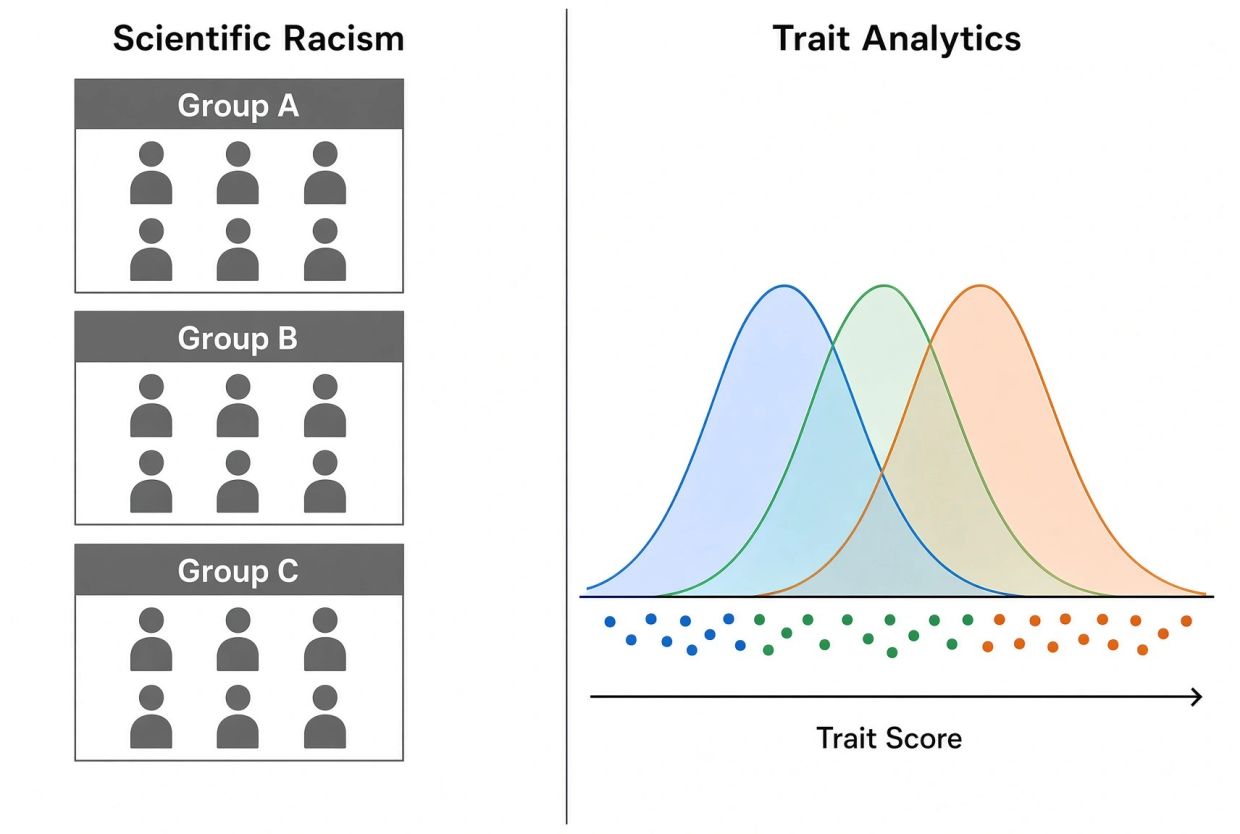
Scientific racism treated entire populations as fixed ranks—superior or inferior as blocs. That method could not isolate the alleles and phenotypes that actually move fitness. It could not tell a portable Mendelian variant from a polygenic stack.
Arx measures discrete, heritable attributes: general cognitive ability and its subcomponents, emotional stability, impulse control, physical robustness, metabolic efficiency, immune competence, fertility, and phenotypic coherence. The unit of analysis is the trait, the polygenic score, the developmental record, and the lineage that carries them. Group averages exist and are not denied but they are not the selection instrument.
Why Group Labels Are Too Coarse
Complex traits are polygenic and largely additive. Within-group variation is large. Alleles recombine. A population mean is a distribution, not a sentence on every member. Selecting “the race” therefore both over-includes and under-includes: it keeps low-fitness individuals inside the favored bin and discards high-fitness carriers outside it.
Arx therefore opens the bin. It extracts what works and compounds it under closed-loop, high-trust conditions. That is trait analytics. It is not a claim that all ancestries are interchangeable, and it is not a claim that wide outcrossing is costless.
The Blue-Eye Example
Blue eyes illustrate the difference.
The principal derived variant (rs12913832 in HERC2, acting on OCA2) arose in European-derived populations roughly 6,000–14,000 years ago. It is Mendelian, portable, and already treated on this site as a case of rapid trait amplification—driven by a mix of sexual selection, frequency-dependent preference, possible greenbeard dynamics, and secondary visual effects in low light. Because the allele travels, it appears in admixed non-Europoid individuals whenever European ancestry has introduced it.
When the trait itself is the target, Arx selects the phenotype and the allele, not the census category of the carrier. The same rule applies to other high-effect, well-mapped variants that integrate without breaking the surrounding architecture.
That rule does not extend automatically to polygenic ensembles. Cognition, temperament, facial architecture, and developmental stability are not single-locus ornaments. They are stacks. Stacks have epistatic and coherence costs. Trait Amplification and Genetic Concepts therefore treat wide, unmanaged admixture as a different problem from the movement of one well-characterized allele. A blue-eyed admixed individual is evidence that alleles migrate. It is not evidence that every polygenic background is equivalent.
The Target Phenotype
The foundries are built to compound lineages of higher adaptive performance while retaining a coherent Europoid phenotype—fair skin, light hair and eyes where those alleles are present, and the broader facial and developmental architecture those lineages already express. Beneficial alleles of other geographic origin may be retained or introduced only when they raise fitness without fracturing that coherence. Hybrid vigor has a range. Inside closely related Europoid sub-branches it has historically compounded. Across distant ancestries it more often produces misalignment than a free upgrade.
This is not racial essentialism and it is not racial interchangeability. It is trait-level optimization bounded by epistasis, developmental stability, and multi-generational phenotypic coherence.
How Selection Is Done Now
Current instruments are pairing, environment, and selection—not germline rewriting.
Assortative pairing on polygenic and phenotypic axes. Natural conception under optimized conditions. Preimplantation testing and polygenic embryo ranking where participants choose them. Rigorous post-natal evaluation. Residual developmental and environmental variance remains. Selection reduces the lottery; it does not abolish it.
Culling, in this usage, is not state violence. It is the same boundary rule the rest of the site already states: membership, reproductive priority, and continuation inside the foundry are earned and can be withheld.
What Is Not Current Protocol
CRISPR and other germline rewriting tools belong to a later horizon. Present accuracy, mosaicism, off-target risk, and incomplete maps of polygenic interaction are not adequate for safe, routine use in human lineages. Until multi-generational safety data exist, Arx amplifies by selection. It does not rewrite the germline as standard practice.
The Method
Scientific racism sorted people into coarse bins and stopped. Trait science opens the bins, keeps the measurements, and rebuilds lineages on purpose.
That is fit genetic distillation.

Arx prioritizes phenotypic coherence and the compounding of proven adaptive complexes. Distant or indiscriminate admixture produces regression toward intermediate means on polygenic traits and risks outbreeding depression on co-adapted gene suites. Broad hybridization is therefore never the default. Under tightly controlled conditions, however, the deliberate introduction of specific high-value alleles—supported by the full suite of modern artificial reproductive and genomic tools—can expand the adaptive toolkit without permanently diluting the core lineage.
The Default Preference Remains Coherence
High-fitness lineages carry linked genetic and cultural complexes shaped by long selection histories. Maintaining those complexes maximizes the reliability of upward selection. Large-scale genomic mixing with distant populations reliably moves cognitive, temperamental, and many physiological polygenic scores toward intermediate values. Arx therefore treats broad hybridization as a costly intervention to be avoided unless the target benefit is clear, measurable, and recoverable through subsequent selection.
Preferred Toolkit: Precision ART and Genomic Engineering
Modern methods convert what was once crude population mixing into a controlled, multigenerational process:
• IVF and ICSI provide the practical platform for embryo-level intervention at scale.
• Preimplantation Genetic Testing (PGT), including PGT-M for known variants, PGT-A for aneuploidy, and especially PGT-P for polygenic scores, allows simultaneous selection on the target allele and the broader cognitive, temperamental, and health background.
• Gamete genomic screening (sequencing and polygenic scoring of sperm and eggs before fertilization) reduces the number of embryos that must be created and tested.
• Vigorous backbreeding—repeated crossing of carriers back to the high-fitness recipient population while selecting for both the desired allele and high polygenic scores—rapidly dilutes unwanted genomic background.
• Iterative multi-cycle selection compounds gains across successive IVF + PGT rounds.
• Precision gene editing (base editing, prime editing, and related methods) enables direct introduction of well-characterized alleles without the rest of the donor genome when the technology is mature and safe.
• Emerging accelerators such as in vitro gametogenesis (IVG) may eventually allow more generations of selection in shorter calendar time.
These tools make broad genomic admixture a last resort rather than the primary method.
Illustrative Scope of Targeted Introduction
Alleles already present inside European gene pools (such as CCR5-Δ32 pathogen resistance or lactase persistence) require only internal selection, gamete screening, and embryo testing for amplification. More distant adaptive variants—Duffy-null malaria resistance, Inuit metabolic adaptations to high-fat marine diets, Andean high-altitude physiology, or certain HLA immune alleles—can be evaluated for net value. Where the benefit is clear, the preferred path is the narrowest possible genomic intervention (editing or tightly controlled first-generation cross) followed by aggressive backbreeding, polygenic embryo selection, and multi-trait recovery of coherence.
Strict Conditions for Any Introduction
An allele from outside the core lineage may be considered only when:
1. It has clear, measurable net fitness value under the specific conditions of the foundry.
2. The method of introduction is as genomically precise as current technology allows (editing or tight selection preferred; broad hybridization is last resort).
3. Vigorous backbreeding, gamete screening, and iterative embryo selection are applied across multiple generations to dilute non-target ancestry and restore or elevate polygenic scores on cognitive capacity, emotional stability, physical robustness, and other primary targets.
4. Outcomes are continuously measured; lineages that fail to recover coherence are discontinued.
5. The entire process remains internal, voluntary, and subordinated to overall lineage ascent.
Integration with Parallel Excellence Pools
Arx already maintains specialized pools for different trait domains. Once a desired allele has been successfully introduced and backbred to coherence within one pool, controlled recombination with other high-performing pools can distribute it. The objective remains fully stacked individuals who combine the new advantage with undiminished performance on the core polygenic traits.
What Remains Forbidden
Open demographic mixing, large-scale distant admixture, hybridization pursued as a moral or aesthetic absolute, or any process that accepts permanent intermediate means on civilizationally critical traits is incompatible with the model. The full ART and genomic toolkit exists precisely so that valuable alleles can be evaluated and, if warranted, integrated without those costs.
In short, targeted allele introduction is acceptable when it is narrow, technologically precise, multigenerational, and ruthlessly subordinated to the recovery and elevation of overall adaptive excellence. Broad hybridization is the inferior and unnecessary route.