Arx: Conscious human evolution for multigenerational ascent through voluntary order.

Arx Revolution

Arx RevolutionArx RevolutionArx Revolution
Home
Vision
Defining the Revolution
Arx as Incubator
Foundational Principles
Why Lineage?
About
Conscious Evolution
Trait Amplification
Beauty as North Star
Genetic Concepts
Horizon Genetics
Spirituality and God
Arx Architecture
Sociological Architecture
Life Cycle and Formation
Psychology/Neurobiology
Structured Daily Order
Operational Framework
Federation Organization
Local Organization
Revitalizing Small Towns
Culture
Arx as Hospital
Natural Conception/ART
Humanoid Robots in Arx
Who Is Arx for?
How an Arx Pays
Join Us
FAQ
Privacy Policy

Arx Revolution

Arx RevolutionArx RevolutionArx Revolution
Home
Vision
Defining the Revolution
Arx as Incubator
Foundational Principles
Why Lineage?
About
Conscious Evolution
Trait Amplification
Beauty as North Star
Genetic Concepts
Horizon Genetics
Spirituality and God
Arx Architecture
Sociological Architecture
Life Cycle and Formation
Psychology/Neurobiology
Structured Daily Order
Operational Framework
Federation Organization
Local Organization
Revitalizing Small Towns
Culture
Arx as Hospital
Natural Conception/ART
Humanoid Robots in Arx
Who Is Arx for?
How an Arx Pays
Join Us
FAQ
Privacy Policy
More
  • Home
  • Vision
  • Defining the Revolution
  • Arx as Incubator
  • Foundational Principles
  • Why Lineage?
  • About
  • Conscious Evolution
  • Trait Amplification
  • Beauty as North Star
  • Genetic Concepts
  • Horizon Genetics
  • Spirituality and God
  • Arx Architecture
  • Sociological Architecture
  • Life Cycle and Formation
  • Psychology/Neurobiology
  • Structured Daily Order
  • Operational Framework
  • Federation Organization
  • Local Organization
  • Revitalizing Small Towns
  • Culture
  • Arx as Hospital
  • Natural Conception/ART
  • Humanoid Robots in Arx
  • Who Is Arx for?
  • How an Arx Pays
  • Join Us
  • FAQ
  • Privacy Policy

  • Home
  • Vision
  • Defining the Revolution
  • Arx as Incubator
  • Foundational Principles
  • Why Lineage?
  • About
  • Conscious Evolution
  • Trait Amplification
  • Beauty as North Star
  • Genetic Concepts
  • Horizon Genetics
  • Spirituality and God
  • Arx Architecture
  • Sociological Architecture
  • Life Cycle and Formation
  • Psychology/Neurobiology
  • Structured Daily Order
  • Operational Framework
  • Federation Organization
  • Local Organization
  • Revitalizing Small Towns
  • Culture
  • Arx as Hospital
  • Natural Conception/ART
  • Humanoid Robots in Arx
  • Who Is Arx for?
  • How an Arx Pays
  • Join Us
  • FAQ
  • Privacy Policy

Structure first, Everything else follows. Structure is the first freedom, and A shared rhythm is infrastructure—the quiet architecture of power. Rhythm raises civilizations.


Arx Revolution

Arx Schedules

The Highly Structured Nature of Arx

Arx life is deliberately highly scheduled. Unstructured freedom, left to pure individual whim or the ambient patterns of modern culture, systematically under-optimizes human development, energy allocation, child-rearing, and long-term lineage outcomes.

The design treats the human organism as a system with known biological constraints and peak-performance windows. Scheduling is the practical mechanism that enforces those constraints at scale inside a closed, intentional community.


Core Reasons Rooted in Optimization

Developmental windows are real and non-negotiable.

Critical periods for attachment security, language, executive function, physical competence, and identity formation close. The Life Guide Pyramid and pod-mentor structure, with age-banded ratios and Erikson-aligned milestones, exist so that the right inputs—care intensity, challenge, modeling, and rest—arrive when the nervous system and body can best absorb them. Drift or “whatever the adults feel like today” produces measurable regression to the mean in capability and coherence across generations.


Energy, attention, and willpower are finite and depletable.

Even high-agency men and women face circadian limits, decision fatigue, and opportunity cost. Fixed blocks for training, deep work, communal meals, recovery, ritual, and reproductive/sexual time remove constant micro-negotiation. The schedule externalizes self-regulation so cognitive bandwidth remains available for higher-order creation and stewardship rather than daily re-planning.


Alloparenting and multi-adult child-rearing require coordination, not vibes.

When child-rearing is deliberately distributed rather than left solely to nuclear pairs, synchronized hand-offs, sleep protection, skill modeling, and load-balancing become mandatory. Without a shared temporal architecture the system collapses into uneven burden, resentment, or neglect of the next generation—the exact failure mode Arx is engineered to escape.


Phenotypic and cultural coherence compounds only under repetition.

Consistent daily and weekly rhythms—physical culture, aesthetic environment, narrative framing, and seasonal festivals—create the environmental pressure that selects for and stabilizes the traits the community values. Sporadic exposure produces weaker internalization and faster dilution.


Exit and voluntarism still require a default operating system.

People can leave; the schedule is not a prison. But a high-functioning closed system needs a strong default tempo so that the majority who stay are not continually renegotiating the basics. The schedule is the antifragile skeleton that lets individual initiative operate on top of a stable base rather than having to invent the base every morning.


In short: Arx treats human optimization as an engineering problem with biological, developmental, and sociological constraints. A highly scheduled life is the control system that keeps those variables inside productive ranges generation after generation, instead of hoping ambient modern randomness will somehow produce the same result.

Science-Based Scheduling for Wellbeing

Science-Based Scheduling for Wellbeing

Science-Based Scheduling for Wellbeing

At Arx, time is not an arbitrary resource to be extracted. It is the foundational architecture of human health, happiness, developmental optimization, and operational excellence. Standard industrial and conventional school schedules rely on rigid, outdated models that ignore human biology—producing burnout in adults, fragmented development in the young, high turnover, and stagnant long-term outcomes.

Arx bridges Industrial-Organizational Psychology, Chronobiology, Developmental Science, Neuroscience, and Sociology to engineer dynamic schedules that protect human vitality across the lifespan while driving multi-generational capability. The system rests on a single principle applied to both adults and offspring: wellbeing and sustained performance emerge when the nervous system feels both appropriately stimulated and fundamentally safe.


The Biology of Our Rhythms

When daily structure conflicts with natural human biology, the result is physiological stress, decreased cognitive performance, emotional fatigue, and—in the case of the young—missed developmental windows. Arx designs schedules around biological and developmental reality:

•  Circadian and Ultradian Alignment. Forward-rotating patterns and chronotype-aware placement are used for adults. For offspring, daily blocks are timed to developmental energy curves and natural attention rhythms. High-demand cognitive or physical work lands when capacity is highest; recovery is treated as non-negotiable for both groups so the neuroendocrine system can return to baseline rather than accumulating chronic load.

•  Developmental Windows. Critical periods for attachment, language, executive function, physical competence, and identity formation are real and time-limited. The schedule ensures the right intensity of care, challenge, modeling, and rest arrives when the nervous system can best absorb it.


Engineering the Balance: Novelty and Protected Monotony

Monotony without relief produces hedonic adaptation and disengagement. Constant novelty without anchors produces anxiety, decision fatigue, loss of mastery, and—for children—insecure attachment or overstimulation. Arx solves this dilemma for both adults and offspring through a stable core surrounded by measured, recoverable variation.


Structural Anchoring (“Protected Monotony”)

Core anchors remain highly consistent. For adults this includes fundamental training patterns, key recovery practices, and certain deep-work modalities; sleep timing is more structured while on-shift to support presence and performance, while off-shift periods allow greater personal flexibility in sleep windows. For offspring, sleep windows are kept quite predictable as a core developmental anchor, along with daily meal times with their Life Guides, stable pod membership, the reliable presence of the same Life Guide sets within each two-year block, and a clear weekly rhythm. These anchors become automatic. Automaticity frees cognitive resources, enables progressive mastery, and supplies the psychological safety required for both high performance and secure development.


Dynamic Intermittent Rotation & Stimulus Freshness

Tasks, emphases, and activity types are re-introduced only after calculated intervals so they regain novelty value. This applies to adult work modes and to offspring learning modalities (indoor skill work, outdoor challenge, project immersion, reflective practice). Micro-novelty—small environmental, sensory, or framing shifts—is used for both groups at doses that elevate engagement without destabilizing the underlying rhythm.


Social-Contextual and Identity Dimensions

Social density, partner type, and interaction meaning are varied on measured cycles for adults. For offspring, continuity of pod-mates, Life Guides, and Pod Mentors is deliberately protected while still allowing controlled exposure to traveling trainers, festival gatherings, and age-appropriate new social configurations. Role and activity cycles reinforce coherent identity across the lifespan—creative, physical, analytical, relational, and exploratory modes appear in spaced but recurring patterns.


Cognitive and Developmental Load Balancing

High-focus periods, lower-intensity execution, recovery, novelty, and stable anchors are distributed for adults and scaled developmentally for offspring. Engagement and vitality signals inform adjustments so neither group drifts into chronic under- or over-stimulation.

These mechanisms sit inside hierarchical periodization: daily/ultradian structure, weekly/monthly rotation, multi-month macro cycles, and multi-year developmental arcs.


Weekly Rhythm and Life Guide Cycles

Offspring follow a clear weekly cadence rather than an unbroken sequence of identical school days. Five days are structured learning days. Saturday is a more free-flow or special-activity day that allows greater exploration, project immersion, and spontaneous engagement. Sunday carries a more meditative, contemplative, and spiritually oriented focus. This weekly oscillation itself supplies measured variation while the underlying relational and caregiving structure remains stable.

Life Guides operate on a recurring 3.5-day on-shift / off-shift cycle that aligns with this broader rhythm. During on-shift periods the daily structure follows the character of the day itself: highly predictable learning blocks on the five structured days, a more free-flow or special-activity pattern on Saturday, and a more contemplative, meditative focus on Sunday. Communal meals taken with the offspring, relational presence, and evening wind-down remain consistent anchors across all days, protecting both caregiving quality and Guide capacity.

Higher-intensity physical training for Life Guides is scheduled as formal training blocks, when fill-ins maintain ratios. This allows Guides to meet their own physiological and performance needs while remaining within the on-shift cycle and returning fully present for communal meals and the remainder of the day.

To create genuine recovery and vacation windows (including longer 10.5-day blocks), Life Guides periodically work consecutive 3.5-day on-shift periods—doubles or, less frequently, triples. These extended rotations maintain ratios and relational continuity while preserving normal nightly sleep and shared night-time coverage; the on-call responsibility alternates so that rest remains protected. Fill-ins and floaters provide additional support capacity as needed. Off-shift time is primarily for rest and recovery, with greater personal flexibility (including around sleep timing); higher-intensity adult social time, when it occurs, is also scheduled into these periods so it does not compete with caregiving presence. The result is a clean separation of modes: focused, high-presence care when on-shift; fuller restoration when off-shift.


Seasonal, Programmatic, and Modular Structure

Where natural seasons exist, collective emphasis shifts with them for the whole community—depth and consolidation, expansion and initiation, high physical and social intensity, harvest and transmission—while protected cores remain stable. Intensity and content for offspring also adapt seasonally (more outdoor exploration and physical challenge in warmer periods, deeper indoor project and reflective work in colder ones) without breaking relational continuity.

In locations with little or no natural seasonal variation, designed multi-month programmatic cycles of comparable contrast are used. Lighting, temperature, botanical displays, soundscape, spatial configuration, and festival calendars supply differentiated input. The year-round modular learning calendar—blocks of structured developmental activity separated by short recovery intervals and longer festival/recovery periods—keeps offspring within stable pods and Life Guide sets across the entire year, eliminating the attachment strain and re-entry friction of conventional long breaks.


Why It Matters Across the Lifespan

Schedules that respect human biology and development produce measurable outcomes for both adults and the next generation:

•  Retention and Capacity in Adults. Protected recovery, autonomy inside structure, identity coherence, and recoverable novelty keep capable people performing at a high level across decades.

•  Secure Development in Offspring. Predictable anchors plus measured variation protect attachment, allow mastery to compound, and deliver challenge at the right developmental moment.

•  Cognitive and Physical Productivity. Circadian and energy-curve alignment, reduced allostatic load, and prevention of habituation sustain performance and learning.

•  Social Coherence. Clear community rhythms reduce role conflict, support belonging, and still supply collective high-intensity events and genuine adult recovery time without sacrificing the steady presence the young require.


By applying the same scientific logic—biological alignment, enough stable repetition for safety and mastery, measured novelty for engagement, and genuine recovery—to both adults and offspring, Arx builds communities that compound human capacity across generations rather than depleting it.

Non-Life Guide Staff Roles and Schedules

Staff Roles and Schedules

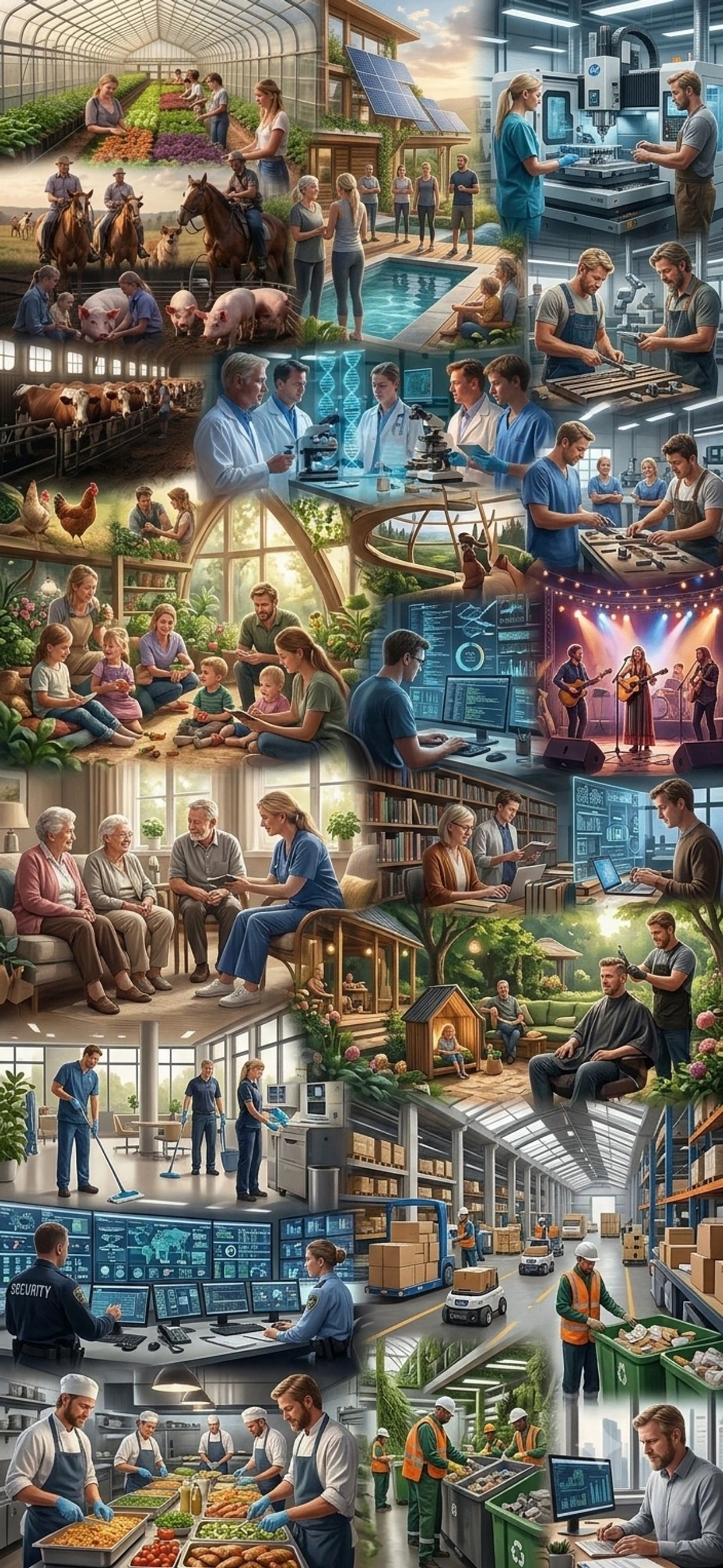
Non-Life Guide staff form the operational, cultural, and supportive backbone of every Arx arcology. Their work sustains the physical, digital, agricultural, medical, educational, economic, and symbolic systems that allow Life Guides, Pod Mentors, and Traveling Trainers to focus on direct relational caregiving, lineage stewardship, and conscious evolution. Roles are assigned according to aptitude, reliability, cultural alignment (work experience culture), and contribution. Many positions, especially in early prototypes or smaller Arxes, are multi-functional to maximize human capital and antifragility.


Important note on scheduling: Doubles and triples (extended consecutive work periods of 7 or 10.5–14 days) are for Life Guides and related frontline caregiving cohorts. Non-Life Guide staff operate on standard recovery-oriented schedules. Continuous 24/7 coverage for essential roles is usually achieved through rotating multi-crew systems with overlapping shifts rather than individual extended duty.


Standard breaks: All non-Life Guide staff receive two paid 15-minute breaks and one 30–60 minute meal break during each shift. Breaks are taken in green spaces, lounges, warming huts, or other quiet recovery areas as available.

Schedules prioritize continuity, recovery, cognitive performance, and the high-trust, merit-based character of the community.


Staff-to-Resident Ratios

Staffing ratios are intentionally richer in early-stage prototype Arxes (roughly 50–150 residents) to allow systems to be refined under real conditions. Mature, small arcologies (400–1,000+ residents) and large full scale arcologies (10,000–100,000+ residents)  operate with greater efficiency through specialization, strong Floater support, and network sharing while still protecting quality and recovery.

Life Guides maintain the tightest ratios, especially with younger cohorts: approximately 1:3 to 1:4 in prototypes and 1:5 to 1:7 in mature systems once Pod Mentors and Floaters are fully effective. Developmental, Wellness, and Attachment support roles together target roughly 1:25–1:40 in prototypes and 1:50–1:80 at scale. Combined medical staffing (nurses and doctors) aims for 1:40–1:60 early on and 1:80–1:120 once the population is larger and healthier baseline conditions are established. Security operates at approximately 1:50–1:80 in prototypes and 1:100–1:150 in mature Arxes, reflecting the high-trust environment. Culinary and food systems staff target 1:25–1:40 early and 1:50–1:70 at scale. Facilities, janitorial, and maintenance roles run at roughly 1:40–1:60 in prototypes and 1:80–1:120 later. Tech and IT support is leaner, at about 1:80–1:120 early and 1:150–1:250 in mature systems. All remaining operational and cultural roles combined typically fall in the range of 1:15–1:25 in prototypes and 1:30–1:50 once the community is fully scaled.

These figures are directional targets, not rigid formulas. Prototypes deliberately run richer staffing; mature Arxes improve efficiency without sacrificing the core standards of care, safety, and recovery.


On-Call Service Level Agreements

Critical roles maintain structured on-call rotations with clear response expectations. Critical medical emergencies (doctors, nurses, and first responders) require immediate acknowledgment and active response or on-site presence within 10–15 minutes. Critical utility and life-safety systems (power, water, HVAC, structural integrity, or major network failure) require acknowledgment within five minutes and active response or remote resolution begun within 15 minutes. Urgent but non-critical technical or maintenance issues target response within 30–60 minutes. Veterinary and animal system emergencies aim for response within 30 minutes, or follow a defined backup protocol when specialists are shared across Arxes. Standard non-urgent on-call matters are addressed on the next scheduled shift or within 4–8 hours depending on severity. On-call periods are limited in duration and frequency to protect recovery, with clear escalation paths and Floater backfill available for prolonged incidents.


Caregiving Architecture Support Roles

These specialized positions enable the Life Guide Pyramid and Erikson-aligned developmental system to function with precision and scalability.


Developmental Coordinators

Orchestrate milestones and systemic coherence. They manage cohort scheduling, track progress against Eriksonian stages, aggregate anonymized biofeedback and assessment data, facilitate quarterly interdisciplinary reviews, coordinate handovers with Traveling Trainers, prepare age-band transition plans, and support resource forecasting and ratio optimization across pods and Arxes. Many enter this role after excelling as experienced Life Guides or Floaters.

Schedule: 8-hour shifts (8:00 AM–4:00 PM or 9:00 AM–5:00 PM), primarily weekdays with rotating weekend coverage as needed. Work 5 days on, 2 days off.


Wellness and Health Integration Specialists

Embed vitality into daily care. They design developmentally calibrated nutrition programs, optimize sleep environments and routines, integrate physical literacy into cohort schedules, support staff fitness and recovery protocols, and coordinate basic health liaison with medical resources.

Schedule: 8-hour shifts (7:00 AM–3:00 PM or 10:00 AM–6:00 PM), rotating weekly. Work 5 days on, 2 days off.


Attachment and Psychological Support Specialists

Safeguard emotional foundations. They conduct or oversee formal attachment assessments, provide consultation and brief interventions, deliver advanced training to Life Guides, and recommend refinements to protocols. Involvement is primarily consultative and preventive.

Schedule: 9:00 AM–5:00 PM, weekdays (with rotating weekend availability for transitions or crises). Work 5 days on, 2 days off.


Environment and Experiential Stewards

Maintain and evolve age-appropriate biophilic spaces and support festival and reunion logistics.

Schedule: 8-hour or 9-hour shifts (8:00 AM–4:00/5:00 PM), weekdays or weekends rotating monthly. Work 5 days on, 2 days off.


Resource and Ratio Logistics Coordinators

Optimize staffing, floater deployment, and material resources across Arxes.

Schedule: 8-hour shifts (8:00 AM–4:00 PM or 9:00 AM–5:00 PM), primarily weekdays with flexible coverage. Work 5 days on, 2 days off.


Elder & Multi-Generational Care Coordinators

Support aging residents, visiting elders, and intergenerational continuity.

Schedule: 8-hour shifts (8:00 AM–4:00 PM or 10:00 AM–6:00 PM), with some evening flexibility. Work 5 days on, 2 days off.


Floater & Relief Pool Coordinators

Manage the dedicated pool of trained Floaters and Fill-Ins who absorb leaves of absence, demand surges, shift handoffs, and temporary coverage gaps.

Schedule: 8-hour shifts (8:00 AM–4:00 PM or flexible coverage windows), primarily weekdays with on-call elements for surge response. Work 5 days on, 2 days off.


Operational, Cultural, and Infrastructure Roles

1. Administrators / Arx Directors & Governance Support

Oversee operations, vision alignment, scheduling, resource allocation, cultural vetting, human resources, and finance.

Schedule: 8-hour shifts (8:00 AM–4:00 PM or 4:00 PM–midnight), rotating as needed. Work 5 days on, 2 days off.


2. Legal, Risk & Compliance Advisors

Handle sovereignty frameworks, contracts, risk management, internal auditing, and dispute resolution.

Schedule: 8-hour administrative shifts (9:00 AM–5:00 PM), primarily weekdays with flexible coverage for urgent matters. Work 5 days on, 2 days off.


3. Enterprise & Revenue Stewards

Oversee the economic engines of the arcology—agri-business, hospitality, educational programs, light manufacturing, and other revenue streams—for long-term self-sufficiency.

Schedule: 8-hour administrative shifts (8:00 AM–4:00 PM or 9:00 AM–5:00 PM), primarily weekdays. Work 5 days on, 2 days off.


4. Network & External Relations Coordinators

Manage federation-level coordination between Arxes and controlled external interfaces.

Schedule: 8-hour shifts (8:00 AM–4:00 PM or 9:00 AM–5:00 PM), primarily weekdays with flexible coverage. Work 5 days on, 2 days off.


5. Cafeteria Workers / Culinary Nutrition Team

Prepare nutrient-focused, developmentally appropriate meals and manage food systems.

Schedule: Split shifts (6:00 AM–2:00 PM or 2:00 PM–10:00 PM), rotating weekly. Work 5 days on, 2 days off.


6. Janitors / General Facilities & Multi-Skilled Maintenance

Maintain facilities, communal areas, green spaces, and daily repairs.

Schedule: 8-hour shifts (7:00 AM–3:00 PM or 3:00 PM–11:00 PM), rotating across crews for continuous coverage. Work 5 days on, 2 days off.


7. Gardeners / Groundskeepers, Landscapers & Biophilic Designers

Tend green spaces and age-appropriate developmental environments.

Schedule: 9:00 AM–5:00 PM, weekdays or weekends rotating monthly. Work 5 days on, 2 days off.


8. Tech Workers / IT Systems Administrators & Network Specialists

Manage digital systems and maintain on-call readiness for critical failures.

Schedule: 8-hour shifts (8:00 AM–4:00 PM or 4:00 PM–midnight), rotating across crews. Work 5 days on, 2 days off, with structured on-call periods.


9. Nurses, Medical Assistants & First Responders

Provide health services, triage, and emergency response.

Schedule: 8-hour shifts (7:00 AM–3:00 PM, 3:00 PM–11:00 PM, or 11:00 PM–7:00 AM), rotating across crews with overlapping handovers for continuous 24/7 coverage. Work 5 days on, 2 days off.


10. Educators / Formal Educators & Vocational Trainers

Deliver nature-based curricula and practical trades education.

Schedule: 9:00 AM–5:00 PM, weekdays or weekends rotating monthly. Work 5 days on, 2 days off.


11. Security Personnel / Community Safety & Emergency Response

Monitor perimeters and facilities while maintaining a high-trust environment with de-escalation focus.

Schedule: 8-hour shifts (6:00 AM–2:00 PM, 2:00 PM–10:00 PM, or 10:00 PM–6:00 AM), rotating across crews with overlapping handovers for continuous 24/7 coverage. Work 5 days on, 2 days off.


12. Farm Workers / Farmers, Permaculturists & Livestock Managers

Manage regenerative agriculture and animal systems.

Schedule: 7:00 AM–3:00 PM, weekdays or weekends rotating monthly. Work 5 days on, 2 days off.


13. Veterinarians & Animal Systems Specialists

Oversee livestock health, breeding support, and biosecurity. Maintain on-call rotation.

Schedule: 8–9 hour days (primarily 8:00 AM–4:00/5:00 PM), weekdays with structured on-call periods. Work 5 days on, 2 days off.


14. Recreation, Event & Festival Coordinators

Organize social events, cultural gatherings, and festival logistics.

Schedule: 10:00 AM–6:00 PM, weekdays or weekends rotating monthly. Work 5 days on, 2 days off.


15. Ritual & Cultural Continuity Specialists

Design and facilitate egregores, seasonal festivals, meditations, storytelling, and initiatory practices.

Schedule: 9:00 AM–5:00 PM or event-driven, with intensified coverage around major peaks. Work 5 days on, 2 days off.


16. Doctors / Physicians & Preventive Medicine

Provide medical care, procedures, and wellness optimization. Maintain on-call rotation.

Schedule: 8-hour shifts (7:00 AM–3:00 PM, 3:00 PM–11:00 PM, or 11:00 PM–7:00 AM), rotating across crews with overlapping handovers for continuous 24/7 coverage. Work 5 days on, 2 days off, with structured on-call periods.


17. Dentists

Provide dental care.

Schedule: 9:00 AM–5:00 PM, weekdays with rotating weekend coverage. Work 5 days on, 2 days off.


18. Barbers

Offer grooming services.

Schedule: 10:00 AM–6:00 PM, weekdays or weekends rotating monthly. Work 5 days on, 2 days off.


19. Program Developers / Data & Analytics Stewards / Innovation Coordinators

Design and maintain software, data systems, and new tools.

Schedule: 8-hour shifts (9:00 AM–5:00 PM or 1:00 PM–9:00 PM), rotating weekly. Work 5 days on, 2 days off.


20. Fabrication, Making & Technical Trades

Light manufacturing, tool-making, modular production, and vocational training.

Schedule: 8-hour shifts (7:00 AM–3:00 PM or 8:00 AM–4:00 PM), primarily weekdays. Work 5 days on, 2 days off.


21. Safety, Engineering & Hazardous Materials Oversight

Provide safety oversight for manufacturing, structural integrity, and hazardous materials.

Schedule: 8-hour shifts (8:00 AM–4:00 PM), primarily weekdays with on-call elements. Work 5 days on, 2 days off.


22. Specialized Maintenance / Building, Utilities & Energy Systems Technicians

Maintain specialized systems and travel between Arxes as needed.

Schedule: 10:00 AM–6:00 PM, 5 days on, 2 days off, with travel assignments of 7–14 days and structured on-call availability.


23. Counselors

Provide mental health support and stress-management workshops.

Schedule: 9:00 AM–5:00 PM, weekdays with rotating weekend shifts. Work 5 days on, 2 days off.


24. Librarians / Archivists & Cultural Preservation Specialists

Manage libraries and multi-generational cultural memory.

Schedule: 9:00 AM–5:00 PM, weekdays or weekends rotating monthly. Work 5 days on, 2 days off.


25. Internal Communications & Media Coordinators

Manage real-time internal communications, broadcasts, and information flow.

Schedule: 8-hour shifts (8:00 AM–4:00 PM or 9:00 AM–5:00 PM), primarily weekdays with flexible coverage. Work 5 days on, 2 days off.


26. Hospitality & Guest Services Managers

Support controlled visitor programs and retreats.

Schedule: 10:00 AM–6:00 PM or flexible event-based shifts. Work 5 days on, 2 days off.


27. Transport & Logistics Coordinators / Procurement & Supply Chain

Manage travel, shuttles, goods movement, and supply flows.

Schedule: 8-hour shifts (7:00 AM–3:00 PM or 3:00 PM–11:00 PM), rotating across crews as needed. Work 5 days on, 2 days off.


28. Waste Management / Utilities & Resource Recovery Workers

Handle recycling, composting, and waste-to-resource systems.

Schedule: 7:00 AM–3:00 PM, weekdays or weekends rotating monthly. Work 5 days on, 2 days off.


This supporting ecosystem enables the caregiving core to function at its highest level while fulfilling Arx’s vision of resilient, self-governing, culturally continuous, and economically viable arcologies. Continuous coverage for essential 24/7 functions is achieved through rotating multi-crew systems with overlapping shifts and defined on-call protocols. Roles scale from combined duties in early prototypes to greater specialization as the network grows. All positions emphasize contribution, recovery, and alignment with the community’s long-term evolutionary aims.
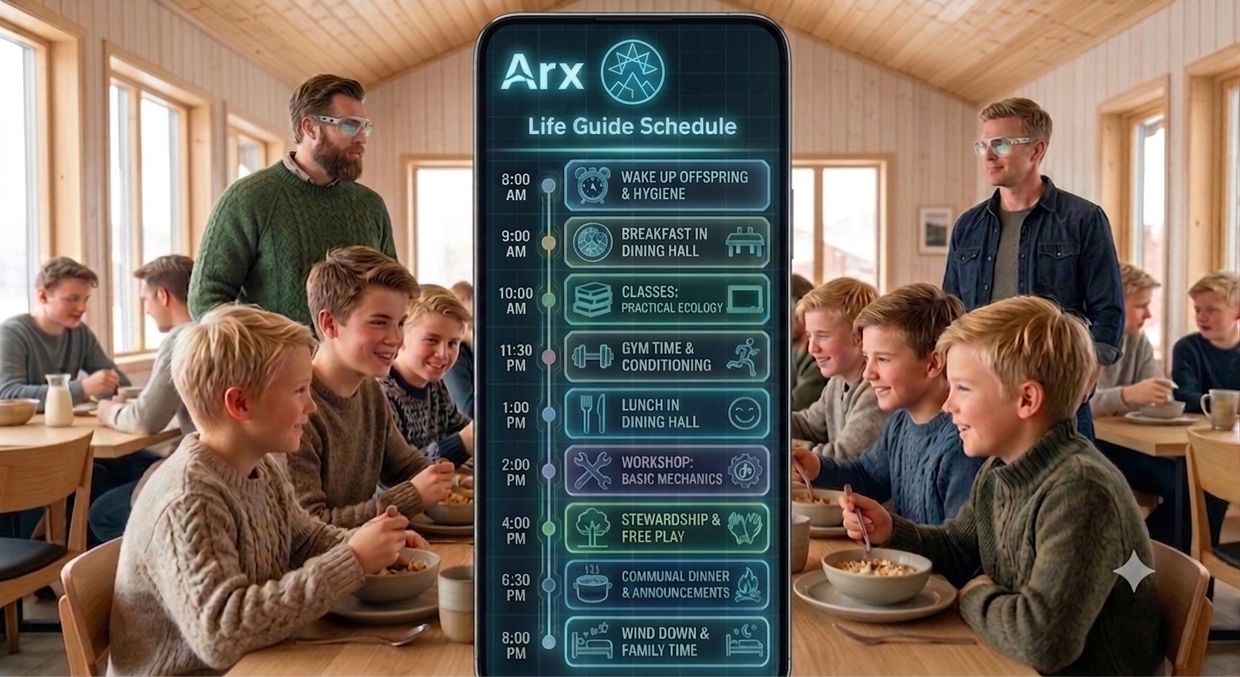

Mealtime is where the cadence of learning softens into community—a shared table where daily rhythms settle, stories are passed down, and care is served as purposefully as the food itself.


Arx Revolution

Arx Learning Year And Daily Rhythm

Arx Learning Year and School Day Daily Rhythm

A Year-Round Modular Calendar for Continuous Development and Relational Continuity

In the Arx model, the traditional industrial school calendar—with its long summer hiatus and abrupt seasonal restarts—is deliberately set aside. Instead, Arx employs a year-round modular learning year designed to sustain developmental momentum, protect secure attachment, and align the rhythms of offspring life with the 3.5-day Life Guide cycle and the broader alloparenting architecture. The calendar prioritizes continuity, seasonal adaptation, and recovery without creating extended gaps that fracture relationships or dilute the steady presence of Life Guides, Pod Mentors, and pod-mates.


Structure of the Learning Year

The year consists of approximately 46–48 weeks of structured developmental activity, organized into modular blocks of 6–8 weeks. Between these blocks are short inter-module recovery periods of 4–7 days. Twice each year, longer 10–14 day festival and recovery blocks coincide with major community gatherings, seasonal markers, or multi-generational reunions. Interspersed throughout are flexible project, expedition, and immersion weeks that count fully as learning time yet shift the mode of engagement—moving from indoor skill sessions into extended outdoor challenges, vocational immersions, or cultural transmission experiences.

This distributed pattern eliminates the single long summer shutdown. Offspring remain within their stable pods and under the guidance of their current Life Guide sets across the entire year. Intensity and content adapt seasonally—more outdoor exploration and physical challenge in warmer months, deeper indoor project work and reflective practice in colder ones—while the underlying relational fabric stays intact. The result is a living calendar that supports Eriksonian progression without the re-entry friction and attachment strain common in conventional systems.


School Day Daily Rhythm Within On-Shift Cycles

On any given school day during a Life Guide’s 3.5-day on-shift, the rhythm is clear and predictable:

•  Early morning hygiene and preparation

•  Communal breakfast shared with the offspring in the dining halls

•  Morning structured learning block (approximately 8:00–11:30/12:00)

•  Communal lunch shared with the offspring

•  Afternoon structured learning or project block (approximately 13:00–15:00/15:30)

•  Afternoon-to-evening recreation, free exploration, skill practice, and community activities

•  Communal dinner shared with the offspring

•  Evening wind-down, reflection, and overnight presence


All three daily meals—breakfast, lunch, and dinner—are taken together in the communal dining halls. Life Guides and Assistants sit with the offspring at every meal. These shared times are treated as high-value relational space: conversation, modeling of manners and presence, gentle social coaching, and the quiet reinforcement of belonging. No Life Guide leaves the dining area during meals while on shift.

During the morning and afternoon learning blocks, Life Guides operate in three integrated modes. They actively facilitate or co-lead sessions, skill work, discussions, and outdoor learning. They provide relational presence and individual scaffolding—sitting with or near specific offspring who need emotional regulation, focused coaching, or quiet support. And they perform light, continuous administrative work: real-time milestone logging through Life Guide-Assist tools, short progress notes, and preparation for handovers. These administrative tasks are kept deliberately lightweight so that the primary energy remains on human presence rather than paperwork.

Physical training for Life Guides is scheduled exclusively inside the morning or afternoon learning blocks. Life Guides step away only while offspring are engaged in formal sessions and return fully present for the next communal meal and all subsequent parts of the day. Fill-ins and floaters cover the precise ratios during these training windows, ensuring no drop in quality or continuity.


Integration with the Broader Caregiving Architecture

Because the calendar is year-round and modular, the demand for coverage remains relatively steady across seasons. This predictability allows the fill-in and floater corps to be sized efficiently and deployed for training windows, short-term absences, professional handovers, special events, and temporary ratio support during high-need developmental periods. Traveling Trainers continue to enrich transition moments and festival blocks. Pod Mentors maintain their long-arc presence throughout the year, appearing at both ordinary days and the larger recovery/festival gatherings.

The modular structure also creates natural points for Life Guide set transitions every two years. Overlap periods of three to six months can be timed to fall across inter-module breaks or lighter project weeks, further smoothing the experience for offspring.


Outcomes for Offspring and the Community

Offspring experience a coherent developmental year rather than a fragmented sequence of academic terms interrupted by long absences. Secure multi-layered attachments are protected because the same pod-mates, the same Life Guide sets within each two-year block, and the same Pod Mentors remain consistent reference points. The three daily shared meals further densify relational contact, turning ordinary nutrition into repeated opportunities for connection and cultural transmission. Seasonal variation prevents monotony while the underlying rhythm of care stays reliable. Life Guides benefit from a sustainable daily structure that protects both their physical training and their recovery time, while the year-round design reduces the staffing volatility that long traditional breaks would otherwise create.


In this way, the Arx Learning Year and School Day Daily Rhythm transform the calendar itself into an instrument of conscious evolution. Time is no longer divided into “school” and “not school,” but is shaped as a continuous, living continuum of growth, relationship, and seasonal adaptation—always held within the stable web of alloparental care that defines the Arx approach to raising the next generation.

Copyright © 2026 Arx Revolution - All Rights Reserved.

Powered by

  • Privacy Policy

This website uses cookies.

We use cookies to analyze website traffic and optimize your website experience. By accepting our use of cookies, your data will be aggregated with all other user data.

DeclineAccept