Arx: Conscious human evolution for multigenerational ascent through voluntary order.

Individuals, Twins, Pods, Confidants, Bands, Clans, Tribes, and Chiefdoms
Arx arcologies are organized as nested layers of relationship calibrated to the real limits of human emotional capacity. These layers follow Dunbar’s numbers—the approximate sizes at which different intensities of bond can remain stable and felt. The structure is built around the lived experience of the young: the gradual widening of trust, belonging, and emotional responsibility from the self outward. Because many will eventually leave their birth arcology for other Arxes or the wider world, the layers exist to form deep emotional roots rather than permanent institutional membership. What remains after dispersal is the quality of the bonds themselves.
Individual (Size: 1)
Everything begins with the individual young person. Before any group can hold, the child must develop a coherent sense of self—agency, emotional honesty, bodily competence, and a growing inner compass. Without this foundation, every later attachment becomes dependency rather than relationship. The individual is the living center that all other bonds circle around.
Twins (Size: 2)
The first and most intimate relational unit is the twin pair. Two age-peers form a primary bond of daily presence, mutual accountability, and long-term loyalty. At this scale there is nowhere to hide; neglect or drift is immediately felt. For the growing person, the twin is the first mirror and the first witness—someone who knows their strengths and soft places without the softening distance of a larger group. This pair becomes the emotional core from which every wider circle is built.
Pods (Size: 4)
A pod is two twin pairs. This is the densest everyday circle of shared life. In the eyes of the young, the pod is the place where belonging is felt most constantly—where every voice is heard, every presence noticed, and every absence registered. It is the primary container for day-to-day formation and for learning how to stay in relationship when things become difficult.
Confidants (Size: 10–15)
Confidants gather several pods into a trusted circle large enough for broader support yet still small enough that each person remains known in their particular strengths, struggles, and current season of life. Here the young person first experiences a slightly wider web of care and honest correction. The upper end of this range matches the classic confidant or sympathy-group size. Emotionally, it is the scale at which a child or adolescent still feels “these people actually know me.”
Bands (Size: 20–50)
Bands bring multiple confidant circles into a living unit large enough for shared rhythms and sustained presence, yet still small enough that most faces remain recognizable. For the young, the band is the first real experience of a community that can carry them without dissolving into anonymity. Tighter bands emphasize cohesion and felt belonging; larger ones introduce more differentiated contributions. The emotional lesson is that one can matter inside a group that is no longer intimate, yet still human-scaled.
Clans (Size: 100–150)
The clan is the largest circle in which personal knowledge of most members remains possible. At the classic Dunbar number of roughly 150, reputations still carry weight and free-riding is hard to conceal. For the growing person, the clan is the primary source of collective identity, story, and the felt sense of “my people.” It is the practical ceiling of face-to-face belonging inside a single arcology or tightly linked cluster of residences.
Tribes (Size: 500–1,500)
Tribes link several clans across related arcologies or a wider regional network. Personal acquaintance is no longer universal, so the quality of relationship shifts from daily familiarity to shared standards, periodic gatherings, and trusted lines of connection. For the young who may one day leave, the tribe offers a larger field of belonging that can travel with them: a sense of extended kin and common purpose that does not require constant physical presence. Emotional continuity is maintained through ritual, memory, and aligned practice rather than constant proximity.
Chiefdoms (Size: 1,500–5,000+)
Chiefdoms are the highest coordinating layer currently envisioned. They hold multiple tribes and safeguard continuity of purpose across generations and geography. At this scale, personal emotional bonds give way to delegated care, transparent forms, and the larger horizon of meaning. From the perspective of youth, the chiefdom is less a felt relationship than a protective frame—the largest circle that still claims them as part of something lasting, even as they prepare to carry the smaller, deeper bonds outward into other Arxes or the wider world.
The entire architecture is oriented toward the formation of resilient emotional capacity. The nested layers exist so that the young person grows inside circles of increasing size and decreasing intensity, learning both intimacy and scale. When adulthood brings dispersal, what travels with them is not institutional membership but the lived memory of being known, held, and called into relationship at every level from twin to clan.

From Twins to Clans and Beyond
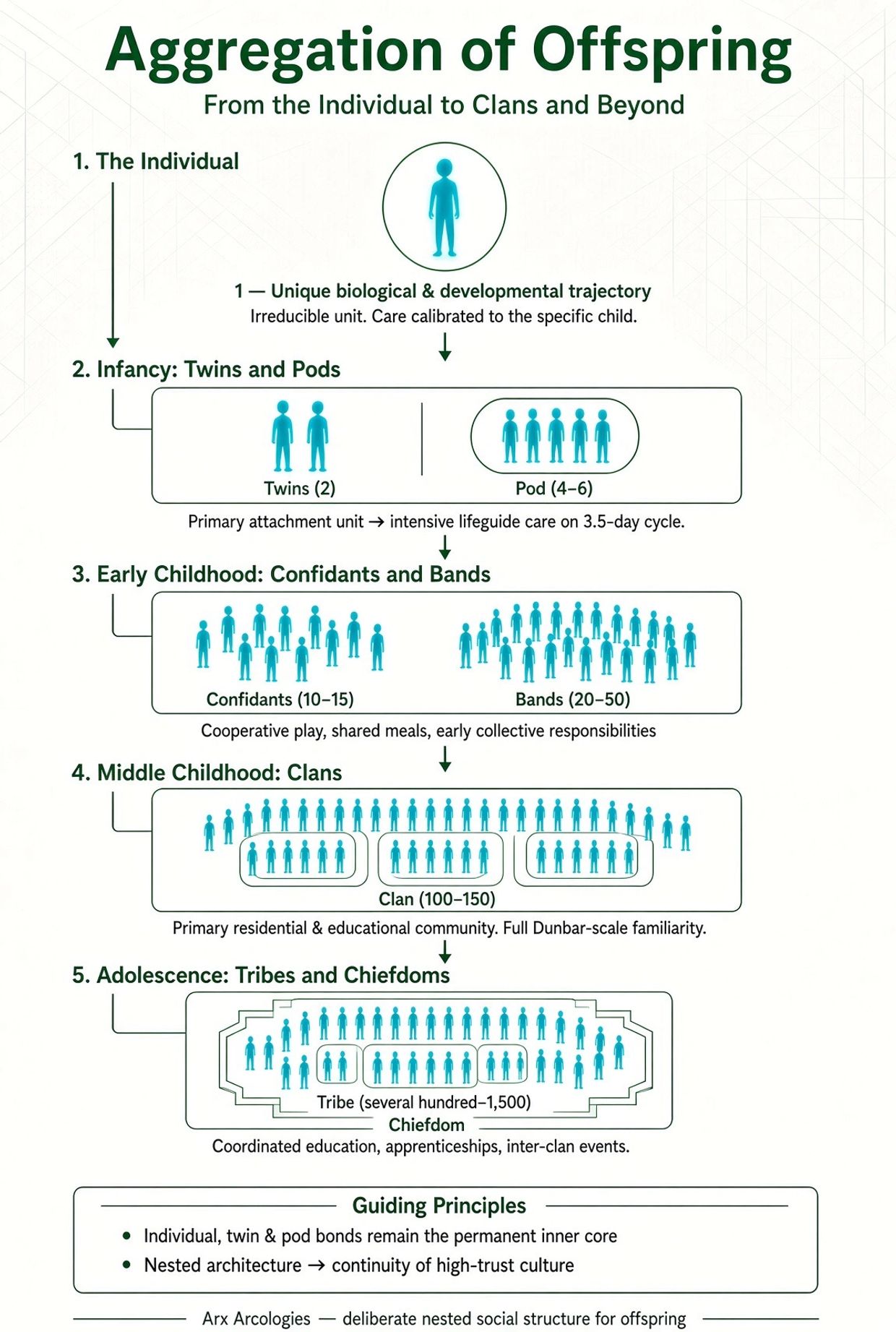
In Arx arcologies, offspring are raised within a deliberately nested social structure that expands with age. Twins, pods, confidants, bands, clans, tribes, and chiefdoms—are applied to the young and are introduced progressively. Children begin in the smallest, most intimate units and gradually aggregate into larger groups as their cognitive, emotional, and social capacities develop. This staged expansion preserves close bonds while steadily widening the circle of trust, responsibility, and shared culture.
Infancy: Twins and Pods
From birth, each child is paired with a twin—either a biological sibling or a carefully matched peer. The twin relationship forms the primary attachment unit of two. Two twin pairs are then combined into a pod of four to six children.
Pods remain small enough for intensive, individualized care. Life Guides oversee pods during the standard 3.5-day on/off caregiving cycle. The tight scale allows constant observation, consistent routines, and the early formation of secure attachment.
Early Childhood: Confidants and Bands
As children move through toddlerhood and the preschool years, pods aggregate into confidant groups of roughly 10–15. Several pods share overlapping supervision and begin structured group activities together.
Confidant groups then combine into bands of 20–50. At this stage the ratio of Life Guides to children widens slightly while remaining high enough for close guidance. Bands introduce cooperative play, early skill practice, shared meals, and simple collective responsibilities. Children learn to navigate a larger set of familiar faces without losing the security of their original twin and pod relationships.
Middle Childhood: Clans
By the school-age years, bands aggregate into clans of 100–150. This is the first scale at which the full Dunbar social-group size becomes practical. Within the clan, children know most of their peers and the adult Life Guides by name and role.
Clans become the primary residential and educational community for this age. Daily life, instruction, physical training, and cultural transmission occur largely within the clan. Life Guide teams rotate on the established 3.5-day cycle, with longer “doubles” or “triples” available for rest or inter-arcology exchange. The clan provides a stable, recognizable home base while still allowing movement between smaller nested units for specialized activities.
Adolescence: Tribes and Chiefdoms
In the teenage years, clans link into tribes of several hundred to roughly 1,500. Tribes coordinate education, apprenticeship pathways, larger projects, and inter-clan events. Personal acquaintance is no longer universal, so organization shifts toward clear roles, shared standards, and periodic assemblies.
Tribes themselves sit within the wider chiefdom structure that oversees multiple age cohorts and the broader arcology. At this level, older adolescents begin to experience the full scale of Arx organization.
Guiding Principles
The aggregation process is intentional rather than random. Twin and pod relationships are never discarded; they remain the inner core even as outer layers form. The entire system is designed to produce adults who are fluent in the social architecture—capable of deep loyalty at the small scale and competent coordination at the large scale.
By moving offspring through the nested layers, Arx ensures continuity of culture, accountability, and high-trust relationships from the earliest years onward.

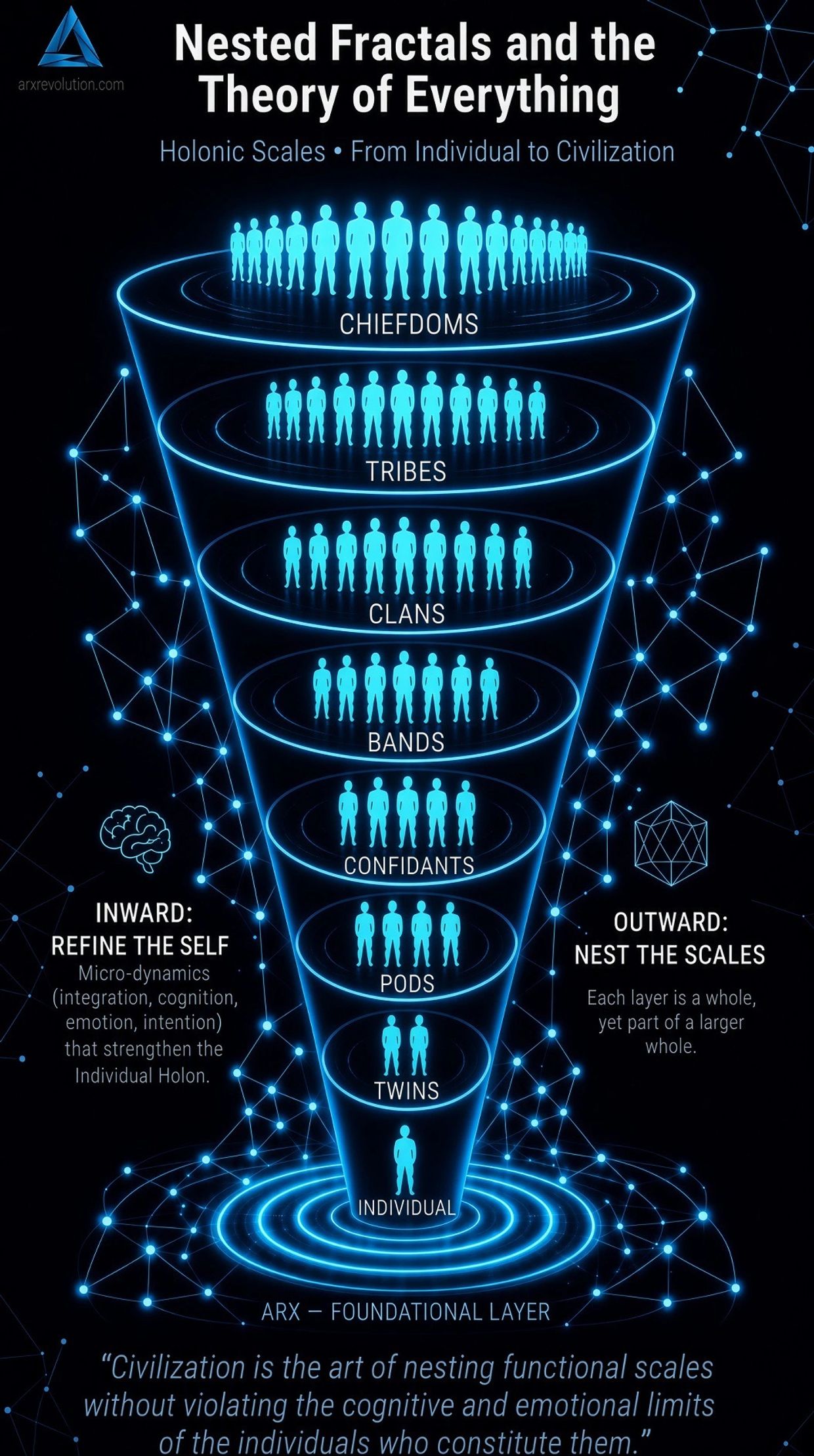
The organizational architecture of Arx is deliberately fractal. The same core pattern repeats at every scale, but it begins with a single, irreducible unit: the individual. In Ken Wilber’s terms, the individual is the primary holon — a whole that is also capable of becoming a part of larger wholes. Every higher layer is built from this foundational holon and must remain accountable to it.
From the individual, the pattern nests outward: twin, pod, confidant group, band, clan, tribe, and chiefdom. Each of these is itself a holon — a coherent whole at its own level and simultaneously a part of the next larger whole. A twin pair is complete in its reciprocity and also a building block of a pod. A clan is a functioning community and also a constituent of a tribe. A single Arx is a stable settlement and also a node in a wider network. Because the structure is self-similar, formation at one level prepares a person for the next. The discipline learned inside a twin pair becomes the grammar of the pod. The reputation dynamics of a clan become the instincts required for tribal or chiefdom responsibility.
Wilber’s larger project, articulated most directly in A Theory of Everything, sought a coherent map that could hold multiple levels without collapsing them into one another. Arx takes up a narrower but parallel task: a theory of everything for human-scale order. It does not claim to explain the physical universe. It claims to explain the conditions under which human groups remain high-trust, high-agency, and capable of multi-generational ascent. The central claim is that civilization is the art of nesting functional scales without violating the cognitive and emotional limits of the individuals who constitute them. When those limits are respected, order can compound. When they are ignored, order decays into bureaucracy, anonymity, and fragmentation.
Because the individual remains the primary holon, the system never treats people as interchangeable units. Trust stays personal at the scales where personal trust is still possible. At larger scales, trust is translated into shared standards, transparent protocols, and institutional memory. The pattern repeats, but the mechanisms evolve to match the magnitude while remaining grounded in the individual.
Arx is the practical test of this thesis. Its nested layers are not an administrative convenience. They are an attempt to build a living demonstration that the holonic pattern — beginning with the individual and nesting cleanly outward — can be made explicit, stable, and generative. If the pattern holds, the same logic that keeps a clan coherent can, with appropriate tools and institutions, keep a network of Arxes coherent. And if a network of Arxes can remain coherent, it becomes possible to raise the baseline of the wider world rather than merely retreat from it.
This thesis therefore moves in two directions at once. Inward, it examines the micro-dynamics of formation, agency, and mutual accountability that make the individual holon strong. Outward, it examines how those same qualities are be preserved, translated, and amplified across larger nested frames. The goal is not a closed system. The goal is a repeating pattern strong enough to improve both the individuals and communities that live by it and the civilization that surrounds them.

Arx is designed as a nested system in which social organization and physical scale reinforce one another. The relationship layers (individual → twin → pod → confidant → band → clan → tribe → chiefdom) set practical limits on trust, coordination, and daily life. Physical size is matched to those limits so that no layer is forced beyond its natural capacity.
In mature operation — once the system is running with high retention — each Arx maintains a relatively stable population. Upon reaching adulthood, some of the next generation move outward to staff new Arxes, while others enter communities in the outside world to raise the civilizational ceiling there. Adults also cycle through roles and, over time, through different Arxes as needed. The result is steady internal population without endless internal growth, while still contributing to broader civilizational improvement.
Clan Scale (100–150)
A clan is the largest group in which most people can still know one another by name, reputation, and function. It forms the practical ceiling for face-to-face community life. A single residential arcology or tightly linked cluster of residences is normally sized to support one stable clan population. This is the core building block of the entire system.
Tribe Scale (minimum four clans)
A tribe links at least four clans and typically operates in the range of 500 to 1,500 people. At this size, universal personal acquaintance is no longer possible, so coordination shifts to shared standards, periodic assemblies, and clear communication channels. A midsize Arx is designed to house one stable tribe — either as a single larger complex or as several clan-scale residences in close geographic and operational relation.
Chiefdom Scale (minimum three tribes)
A chiefdom coordinates at least three tribes and generally operates in the range of 1,500 to 5,000+ people. Governance at this level relies on delegated authority, transparent protocols, and technological tools rather than daily personal bonds. A large Arx is sized to function as one stable chiefdom, providing strategic direction, inter-clan resource flows, and continuity of purpose across multiple tribes.
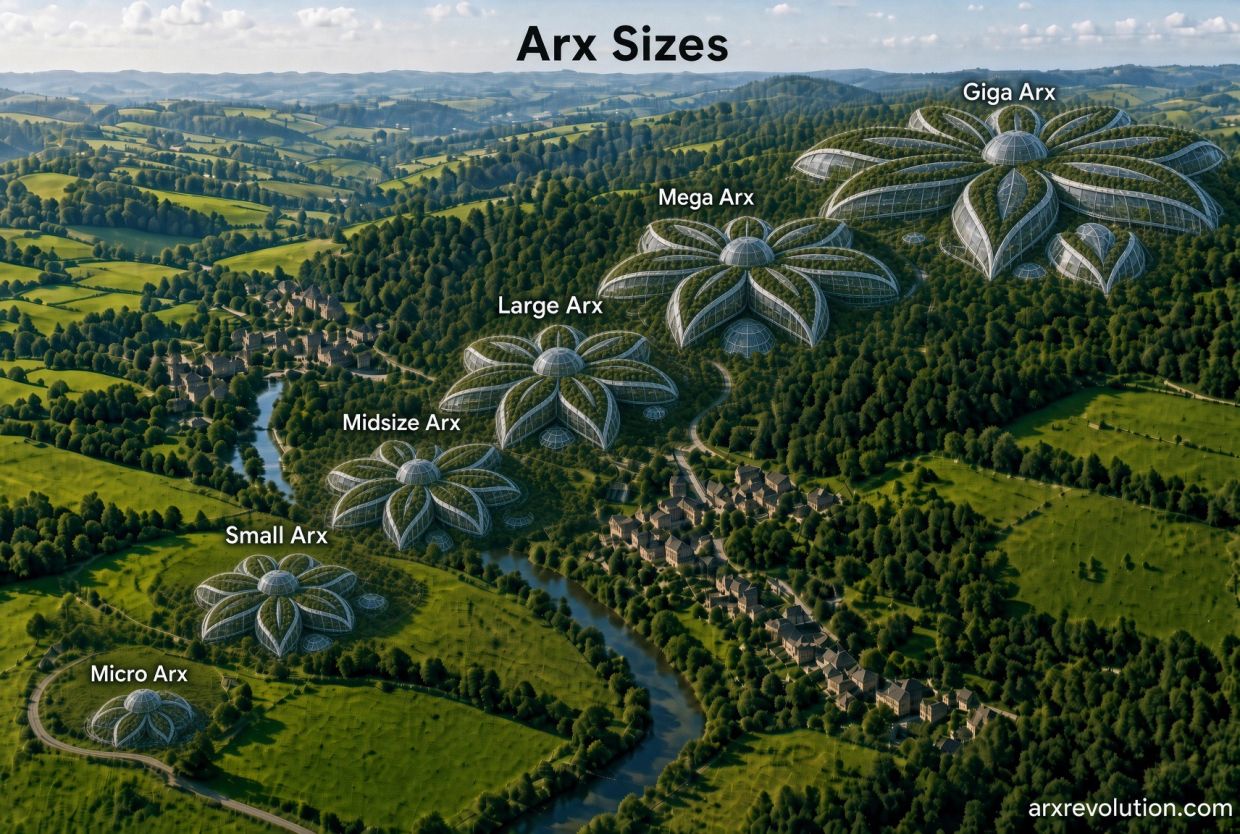
Physical Scale Categories
These social layers map onto a practical range of physical sizes, each designed for stable population:
• Micro Arx
Experimental or starter units, typically the size of a band or confidant group (roughly 20–50 people). Used for early testing of architecture, governance, and daily rhythms before scaling.
• Small Arx
One clan (100–150 people). A complete, self-contained residential and working community. This is the standard entry-level arcology.
• Midsize Arx
One tribe (minimum four clans). A more complex settlement capable of greater specialization, internal resource circulation, and sustained cultural transmission.
• Large Arx
One chiefdom (minimum three tribes). A regional-scale node with full strategic capacity, multiple specialized facilities, and the ability to support long-term institutional continuity.
• Mega Arx
A coordinated cluster of several chiefdoms. Functions as a high-capacity regional system while still preserving the nested social structure beneath it.
• Giga Arx
The largest currently envisioned layer: a continental or multi-regional network of mega-scale systems. Coordination at this level is almost entirely institutional and technological, with the lower layers (clan through chiefdom) remaining the primary sites of daily life and human-scale trust.
The guiding principle remains constant: physical size should never outrun the social layer it is meant to serve. Structures that force people to relate at scales beyond their cognitive and emotional capacity produce bureaucracy, anonymity, and eventual decay. In mature Arx systems, stable populations, the outward movement of new adults into both new Arxes and the wider world, and the cycling of adults through roles keep each layer within its proper bounds while allowing the overall network — and the surrounding civilization — to rise.

Arx as an Individualized Collective
Radical autonomy inside unbroken tribal continuity
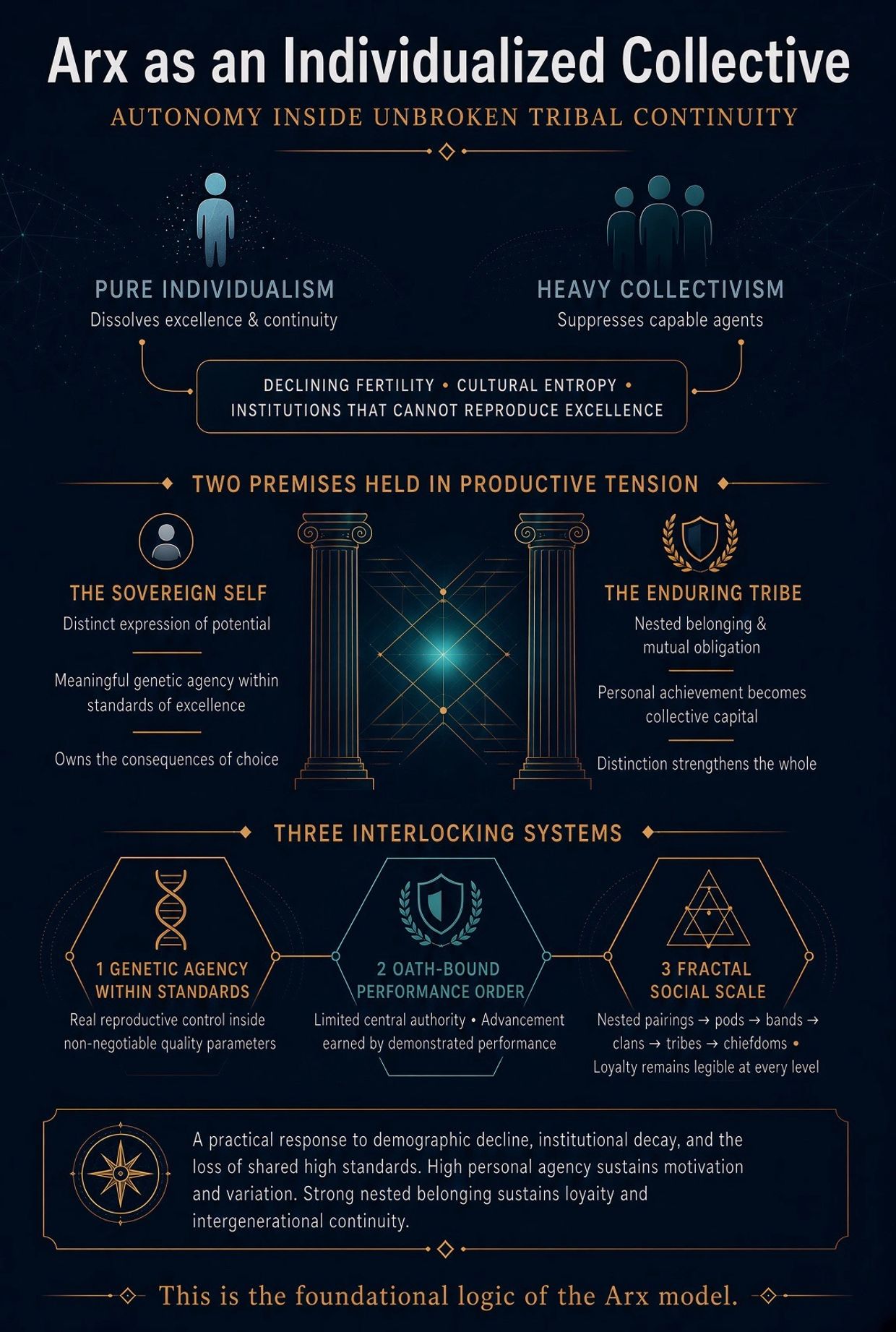
Most modern social forms fail in one of two directions. Pure individualism dissolves the conditions that make excellence and continuity possible. Heavy collectivism suppresses the very agents whose capability the group depends on. The result, in both cases, is the same: declining fertility, cultural entropy, and institutions that can no longer reproduce themselves at a high level.
Arx is built on a different premise. It treats the individual as sovereign and the tribe as sacred at the same time. Personal agency is not diluted for the sake of the group; the group is structured so that it requires and rewards genuine agency. Continuity is not imposed from above; it is generated by people who retain real control over their contribution and their legacy. This configuration is what we call the hyper-individualized collective.
Two Premises Held in Tension
The sovereign self
Each person is regarded as a distinct expression of potential rather than interchangeable material. Reproductive decisions are structured so that individuals exercise meaningful agency over genetic legacy within clear standards of excellence. Autonomy here is not unbounded license. It is constrained choice oriented toward higher capability across generations. The individual owns the consequences of those choices in a way most contemporary systems carefully avoid.
The enduring tribe
Individual life gains continuity and meaning through nested belonging—from the closest pairings outward through successive scales of mutual obligation. Personal achievement is converted into collective capital through explicit commitments rather than diffuse sentiment. Distinction strengthens the whole instead of competing with it. The tribe does not exist to absorb the individual; the individual becomes fully itself inside a structure that demands excellence and returns continuity.
These two premises are not balanced by compromise. They are held in productive tension. The self is more sovereign because the structure recognizes and requires its uniqueness. The collective remains vital because it is composed of agents who have not been reduced to functions.
How the Form Operates
Three interlocking systems make the synthesis concrete.
Genetic agency within standards
Individuals retain significant control over reproductive decisions. Selection occurs inside non-negotiable parameters of cognitive, physical, and prosocial quality. The system is designed to prevent both unconstrained drift and top-down uniformity. Agency is real; the direction of selection is not left to chance or fashion.
Oath-bound, performance-based order
Central authority is deliberately limited. Obligations are carried by explicit commitments rather than expansive bureaucracy. Advancement is earned through demonstrated performance in competitive and cooperative settings. The link between individual effort and social standing is kept direct and visible.
Fractal social scale
Social units expand in a consistent pattern—from the smallest pairings through pods, bands, clans, tribes, and larger chiefdoms. Each level preserves individual recognition while embedding the person in progressively wider circles of mutual investment and identity. Leadership is performance-based. Belonging is nested rather than flat. The structure is designed so that loyalty and accountability remain legible at every scale.
Orientation
The individualized collective is not an abstract ideal. It is a practical response to the simultaneous pressures of demographic decline, institutional decay, and the loss of shared high standards. It aims to produce populations that are demographically robust, culturally coherent, and continuously selected for capability. High personal agency sustains motivation and variation. Strong nested belonging sustains loyalty, mutual investment, and intergenerational continuity.
Arx does not claim to dissolve the ancient tension between self and group. It organizes that tension into a stable, generative form—one capable of carrying lineage, excellence, and meaning forward under conditions that currently erode all three.
This is the foundational logic of the Arx model.