Arx: Conscious human evolution for multigenerational ascent through voluntary order.

Power as Virtue in the Arx Ethos
Power is the capacity to act—the agency, vitality, and will that turns intention into reality. It is the life-force enabling us to create, love, build, steward lineages, and drive conscious evolution. Without it, we face only stagnation. In the Arx vision, true power is generative and radiant, like the sun. It radiates outward from sovereign individuals and fortified communities, amplifying high-fitness traits, defending boundaries, and forging arcologies where beauty and excellence compound across generations.
The sun remains our master symbol. It pours forth light and warmth without domination or extraction, generating life everywhere it touches. This is power in its highest form: not what can be seized, but what can be radiated through disciplined vitality mastered into enduring form. Arx arcologies are built to embody this—self-sustaining citadels that protect and amplify proven lineages, turning surplus energy into multi-generational ascent rather than dissipation or dilution.
The Inner Foundations of Power
Real power begins with mastery over oneself: commanding your responses, cultivating discipline, and building an inner citadel no external chaos can breach. This inward turning creates the stable core from which outward expression can flow without collapse. Paired with it is the drive to expand, overflow, and give form to the world—to create, to shape environments, and to pour vitality into legacy. The synthesis is the sun: contained fire freely given, discipline that enables abundant release. This integration prevents brittleness on one hand and chaotic flood on the other.
Within each sovereign individual, this requires balancing directed will and structure (the drive to act and order) with surrender, intuition, relaxation, and devotion (the receptive pole that allows recovery, depth, and creative flow). These are not outsourced but cultivated internally, forming a complete internal circuit. The man or woman who masters both poles holds tension without breaking, grinds with purpose, and releases into generative overflow. This internal electromagnetic charge sustains long-horizon stewardship essential to Arx.
Masculine Power as Foundation
Masculine power comes first as the foundational force in the Arx ethos. It establishes order, defends boundaries, directs will outward, and builds the citadels that make higher ascent possible. In light form, it protects, structures, and overflows into creation: engineering resilient arcologies, enforcing merit-based selection, securing resources, and driving the deliberate amplification of adaptive traits. It creates the protected environments where lineages can flourish without dilution or external entropy. This is the reactor—disciplined, antifragile, and sovereign—laying the foundation upon which everything else stands.
Shadow masculine power inverts this into crude domination, extraction, brittle control, or hollow force without generative purpose. It consumes rather than builds and leaves nothing enduring. Arx rejects this, insisting on masculine power exercised as virtuous stewardship: boundary defense, meritocratic selection, and the forging of fortified habitats that prioritize proven fitness and phenotypic coherence.
Feminine Power as Generative Force
Once masculine foundations are secured, feminine power can fully radiate as a sovereign generative force. It thrives within those protected structures, manifesting as intuitive wisdom, relational intelligence, generative receptivity, devotion, and the capacity to nurture growth through presence and harmony. In light form, it refines what the masculine frame has built—holding emotional and spiritual containers, perceiving subtle patterns, supporting cooperative child-rearing, and channeling devotion into cultural synthesis and beauty. It transforms structure into living vitality, turning citadels into true incubators of human potential.
Shadow feminine power emerges when this force lacks masculine grounding: manipulation, emotional draining, passive-aggression, or the pursuit of influence through weakness and resentment. It drains rather than elevates. In Arx, feminine power is cultivated as complementary to the foundational masculine drive—both expressed sovereignly and integrated internally—so that protected lineages compound in beauty, resilience, and multi-generational excellence.
Light Forms and Shadow Forms
Arx distinguishes light forms of power—generative, sovereign, and aligned with conscious evolution—from shadow forms that erode or invert it. Masculine power establishes the frame; feminine power animates and refines it within that frame.
Light form masculine builds and defends the foundries. It enforces boundaries, drives selection, and provides the ordered structure for ascent. Shadow form masculine devolves into domination without virtue or brittle extraction that leaves ruins.
Light form feminine, built upon secure foundations, nurtures radiance: relational depth, intuitive refinement, and generative care that elevates the entire system. Shadow form feminine inverts into draining dynamics that undermine the citadel from within.
Together, light forms align with Arx principles: trait amplification, beauty as north star, high-trust meritocracy, and voluntary lineage stewardship. They reject egalitarian dilution, homogenized integration, and dysgenic openness. Shadow forms represent the entropy we counter—flattening variance, eroding fitness, and dissolving the coherent lineages capable of civilizational momentum.
Daily Practice and Lineage Stewardship
Power as virtue is practical and grounded. Each day, prioritize the masculine foundations first: What is the highest-leverage act that strengthens discipline, boundaries, and directed action? Then integrate the feminine generative pole: How do I nurture, refine, and radiate within that structure? Audit leaks (distractions, misalignment, resentment) versus builders (high-agency habits, focused creation, relational harmony). Arx operationalizes this through intentional communities: cooperative yet sovereign child-rearing, technological augmentation, and replicable foundries that scale excellence without compromise.
This is lived ethos, not abstraction. Arx arcologies function as human evolutionary incubators—protected environments where light-form power compounds ancestral strengths, defends against dilution, and orients toward beauty, antifragility, and multi-generational ascent. Participants choose voluntary stewardship: rejecting short-term entropy for enduring legacy.
Toward the Arx Future
In Arx, power as virtue means becoming the sun within sovereign citadels. Masculine power lays the unyielding frame; feminine power brings it to generative life. We reject shadow distortions—whether crude domination or passive draining—in favor of light-form radiance that elevates lineages, builds resilient habitats, and pursues conscious evolution. We amplify what works, defend what is ours, and radiate vitality into forms of enduring beauty.
This path grounds us: disciplined daily practice with masculine foundations first, internal polarity for wholeness, and unwavering commitment to lineage and community. The result is directed ascent—fortified foundries where humanity refines itself for Earth and beyond. Arx calls high-agency individuals to this work. The sun does not seek permission. Neither do we.
Power as virtue, embodied in Arx, turns intention into living legacy.

A Martial and Mystical Archetype for Sovereign Ascent
In the high Middle Ages, Western Christianity achieved one of its most potent and enduring expressions in the Arthurian legends. These were not sentimental tales of passive piety or therapeutic compassion. They were epics of cosmic combat, ordered power, chivalric excellence, and transcendent quest—fusing the martial vigor of earlier European traditions with the Christian drama of victory over death and chaos. For over a thousand years, the dominant reading of Christ in the West emphasized Christus Victor: the cross as divine strategy, the Resurrection as decisive triumph, and the Harrowing of Hell as a raid on the enemy’s stronghold. The Arthurian cycle embodied this vision in story and symbol, while holding in balance the complementary truth of Christus Patiens—suffering willingly embraced for the healing of the land and the restoration of order.
This synthesis offers a living archetype for the Arx Revolution: fortified citadels that defend and amplify proven lineages, meritocratic orders that channel vitality into enduring form, and a higher telos of beauty and ascent that refuses entropy and dilution.
The Medieval Synthesis: Pagan Vitality Baptized into Christian Chivalry
The legends drew from deep Celtic roots—quests into the Otherworld, vessels of abundance and healing, trials of worthiness—yet were consciously Christianized by poets such as Chrétien de Troyes and Robert de Boron in the late 12th and early 13th centuries. The Grail itself evolved from a wondrous cauldron or dish into the cup of the Last Supper that caught the blood of Christ, becoming the supreme symbol of divine grace made manifest in the world.
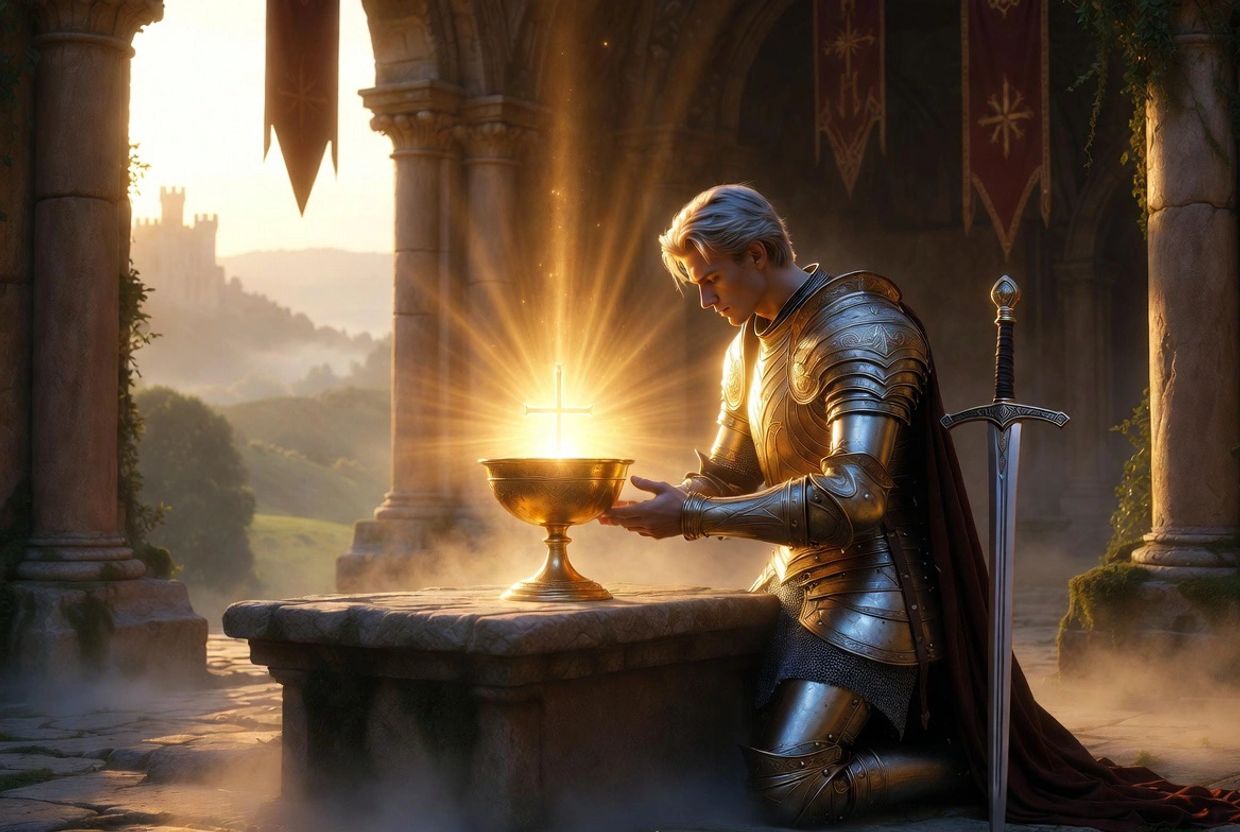
Chivalry was not mere etiquette. It was a warrior code aligned with faith: the knight defended the weak, upheld justice, pursued purity, and waged war against chaos in all its forms—dragons, usurpers, and the internal failings that wound the realm. The sword and the cross were not opposed; the knight was miles Christi, a soldier of Christ whose martial excellence served a higher order. This was Christianity with its teeth intact—before the Victorian softening that reduced the Prince of Peace to sentiment and the Lamb to harmlessness, forgetting the sword that Christ said he came to bring.
Christus Victor: Knights as Stewards of Victory
The Arthurian world pulses with the energy of spiritual combat. Knights ride forth not merely to rescue maidens or slay monsters, but to restore the broken order of the land. The Round Table itself is a meritocratic ideal: men of proven worth gathered in equality of service under a sovereign who draws the sword from the stone by divine right and proven fitness. Flaws exist—Lancelot’s fall, the fractures of pride and passion—but the archetype remains: high-trust brotherhood bound by oath, disciplined by shared standards, oriented toward collective defense and glory.
Excalibur, the sword in the stone, and the great battles represent Christus Victor in narrative form. Victory is not automatic; it demands courage, skill, and alignment with the higher law. The king and his knights stand as citadels against the entropy that would dissolve realm and lineage alike. In Arx terms, they prefigure the sovereign foundry: a closed, high-selection system that amplifies adaptive traits, enforces boundaries, and turns martial vitality into generational strength.
The Grail Quest: Telos of Beauty, Healing, and Lineage
The Quest for the Holy Grail stands as the supreme expression of directed ascent. It is no casual adventure. Only the pure of heart—Galahad above all—can achieve the vision. The Grail heals the wounded Fisher King and restores fertility to the Waste Land. Here Christus Patiens and Christus Victor meet: the king suffers for the realm; the quest demands sacrifice, purity, and perseverance; yet the successful knight returns with healing power that renews the entire order.
The Grail is the ultimate symbol of Beauty as North Star—vitality mastered into radiant, life-giving form. It sustains, elevates, and perpetuates what is highest. In the Arx vision, it parallels the deliberate amplification of high-fitness lineages: the conscious stewardship that turns surplus vitality into multi-generational excellence rather than dissipation. The Waste Land warns against dilution, admixture that fades the divine portion, and the loss of coherent form—precisely the entropy Arx arcologies are engineered to resist.
Holding Both Hands: Victor and Patiens in Tension
Arthurian Christianity refuses the false choice between power and sacrifice. The knight wields the sword in defense of order and beauty, yet the greatest among them achieve victory through willing suffering and self-mastery. The Round Table demands both martial prowess and the inner citadel of discipline and devotion. This polarity—masculine foundational order that protects and directs, feminine generative radiance that heals and elevates within that frame—mirrors the Arx ethos of power as virtue: the sun that radiates without domination, the citadel that enables ascent rather than mere control.
Modern pop Christianity often retains only the lamb and the harm principle. Arthurian legend restores the full symbolic spine: the sword and the cup, the citadel and the quest, the defense of the realm and the healing of the land. It is Christianity as civilizational program—capable of inspiring the Committees of Correspondence-style renewal, town by town and city by city, among those still carrying the older Western programming.
Relevance to the Arx Revolution
Arxes are modern Camelots: sovereign, resilient foundries that defend boundaries, select and amplify proven ancestral genetic and cultural lineages, and orient daily life toward Beauty as the cardinal principle. The peerage and Life Guide structures echo the Round Table’s meritocratic discipline and mentoring of the next generation. The cooperative child-rearing model within high-trust cohorts parallels the extended chivalric household that raised future knights in excellence.
The Grail quest supplies the mythic fuel for the long-horizon work: not preservation alone, but conscious evolution toward higher expression—cognitive acuity, physical robustness, emotional stability, and civilizational competence compounded across generations. The warning of the Waste Land and the fallen Atlantis reinforces the necessity of boundary defense and phenotypic coherence. Arthurian Christianity does not demand uniformity of belief within the broader Arx federation; it offers one of the richest symbolic reservoirs for those drawn to the martial-mystical Western tradition—perfectly compatible with pagan, esoteric, and other aligned paths under the shared commitment to sovereign ascent.
In an age of economic inversion and spiritual hollowing, the legends call us to recover the fuller inheritance: Christianity with its sword sharpened and its banners unfurled, held in living tension with the mystery of redemptive suffering. The citadels we build today can once again become places where the quest is lived, the land is healed, and lineages ascend.
This is the recovery of an operating system that built cathedrals, ordered realms, and sent men on quests whose fruits still shape us. Arx takes up the sword and the cup in the present—for the future.

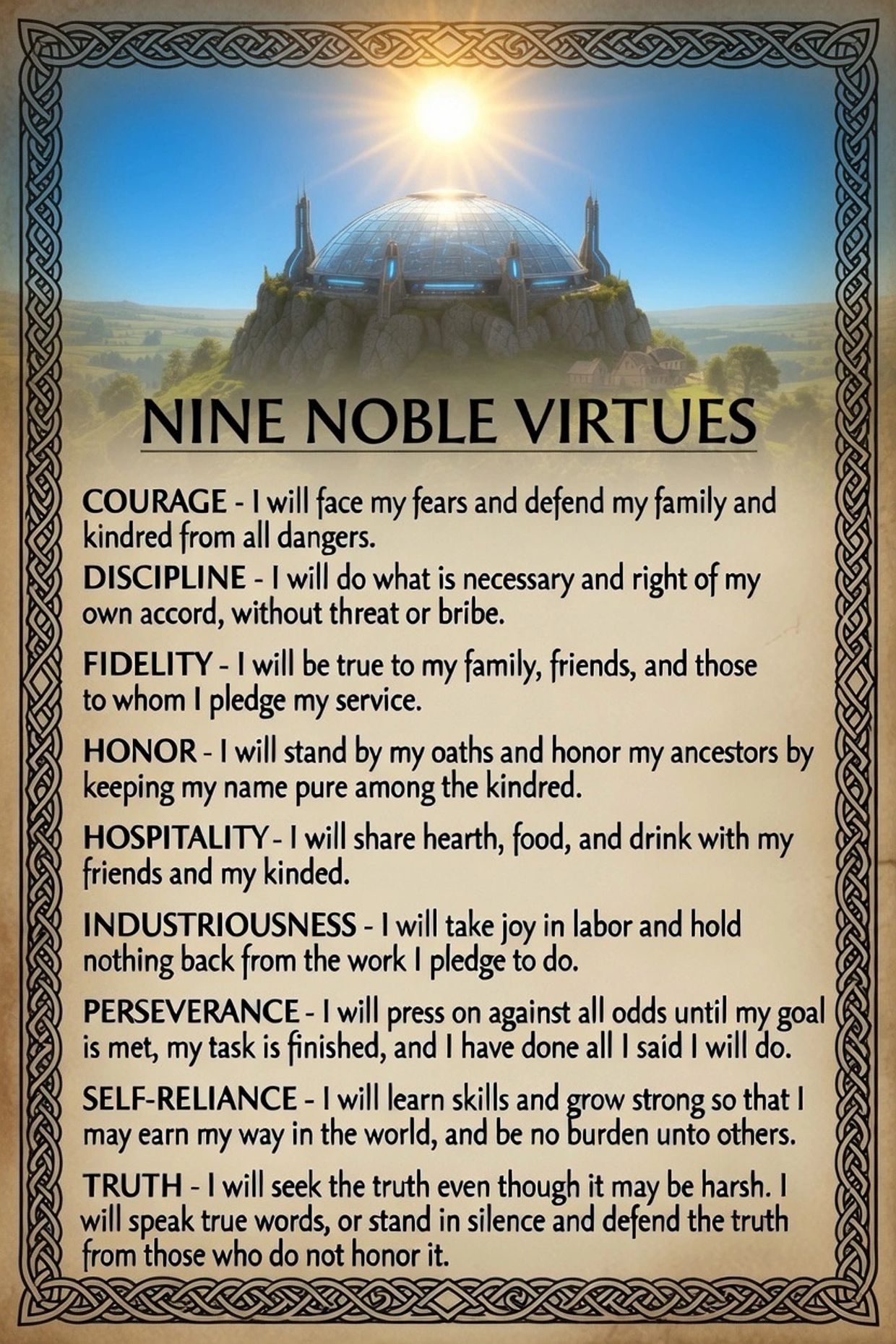
Arx is not built on sentiment, fashion, or imported universalist moral systems. It is built on the deliberate amplification of traits that have already demonstrated multi-generational fitness: cognitive acuity, physical and psychological robustness, loyalty under pressure, productive agency, and the capacity to maintain high-trust cooperation across time. The Nine Noble Virtues serve as a compact, battle-tested ethical operating system that supports exactly those requirements.
Drawn from the practical wisdom of the Hávamál and related Northern European sources, and refined into a usable modern code, the Virtues are not presented as divine commandments or mystical revelation. They are treated as a proven heuristic set for people who intend to build and sustain sovereign foundries across generations. In high-selection, closed-loop communities where membership is earned and boundaries are real, character is infrastructure. The Virtues make that character explicit and trainable.
How the Virtues Map to Arx Requirements
Courage — The willingness to enforce hard boundaries, to speak uncomfortable truths about fitness and dilution, and to accept the personal cost of building something selective rather than popular. Without courage, high standards collapse into accommodation.
Truth — Accurate self-assessment, honest merit attestation, and refusal to flatter or obscure results. In a system that relies on cryptographic proofs of contribution and transparent selection, falsehood is not merely a personal failing; it is a systemic vulnerability.
Honor — Reputation that compounds across time. In Arxes, an individual’s name and lineage are not disposable. Honor binds present action to future consequence and makes multi-generational accountability possible.
Fidelity — Loyalty to sworn peers, to the shared mission, and to the lineages under one’s stewardship. High-trust systems cannot function on temporary alliances or low-cost exit. Fidelity is the social technology that allows cooperative child-rearing, shared risk, and long-horizon planning without constant renegotiation.
Discipline — The daily subordination of impulse to long-term ascent. Foundry life demands consistent standards in training, reproduction, resource management, and cultural transmission. Discipline converts intention into reliable output.
Hospitality — Proper treatment of those who have earned a place inside the boundary. Hospitality is not open-border generosity; it is the reciprocal duty owed within a high-trust circle. It strengthens internal cohesion while reinforcing the distinction between peer and outsider.
Self-Reliance — Competence and personal responsibility as the baseline. Arxes are closed-loop by design. Every participant must be a net contributor of capability, not a net consumer of other people’s agency.
Industriousness — Productive work as a moral and practical necessity. Excellence is not declared; it is forged through sustained output. Idle capacity is treated as a form of entropy.
Perseverance — The capacity to continue under friction, setback, and long timelines. Civilizational projects measure results in decades and centuries, not quarterly cycles. Perseverance is what turns temporary advantage into compounding ascent.
Why This Code Specifically
Many ethical systems emphasize compassion, equality of outcome, or emotional safety as primary goods. Those priorities are incompatible with the core Arx functions of selection, boundary enforcement, and fitness amplification. The Nine Noble Virtues prioritize agency, reliability, and results. They reward the traits that allow a small, aligned group to remain coherent and antifragile under pressure, while discarding the traits that produce free-riding, defection, or gradual dilution.
They also provide a shared moral language that is culturally rooted in the ancestral lineages Arx seeks to amplify, without requiring theological uniformity. Participants may be pagan, Christian, esoteric, or non-religious; the Virtues function as a practical metaculture of character rather than a rival religion. This keeps the focus on measurable conduct and generational outcomes rather than metaphysical disputes.
In short, Arx uses the Nine Noble Virtues because they are a concise, functional code for the kind of people who build citadels instead of waiting for the world to improve on its own. They turn high standards into daily practice, make trust legible, and align individual behavior with the long-term requirements of lineage ascent. Where softer moral frameworks dissolve under pressure, these Virtues stay true. That is precisely what a foundry requires.