Research and Development at Arx
At Arx, research and development is organized around conscious human evolution. The primary work is to measure heritable variation, test selection methods, and determine what can be transmitted across generations inside a high-trust habitat. Genetics, reproductive biology, and developmental science sit at the center of that program. Governance, settlement, and closed-loop engineering are researched as methods that make multi-generation selection measurable and durable. Policy is not treated as a finding. Models are tested.
Areas of research and development at Arx include, but are not limited to:
Conscious selection and population genetics. Heritability estimation for cognitive, health, and behavioral traits. Polygenic score construction, validation, and portability across cohorts. Selection differentials under realistic mate and gamete choice. Allele-frequency change, mutation load, runs of homozygosity, loss of variation, and the decay of prediction across generations. Pre-registered tests for whether a measured differential appears in offspring.
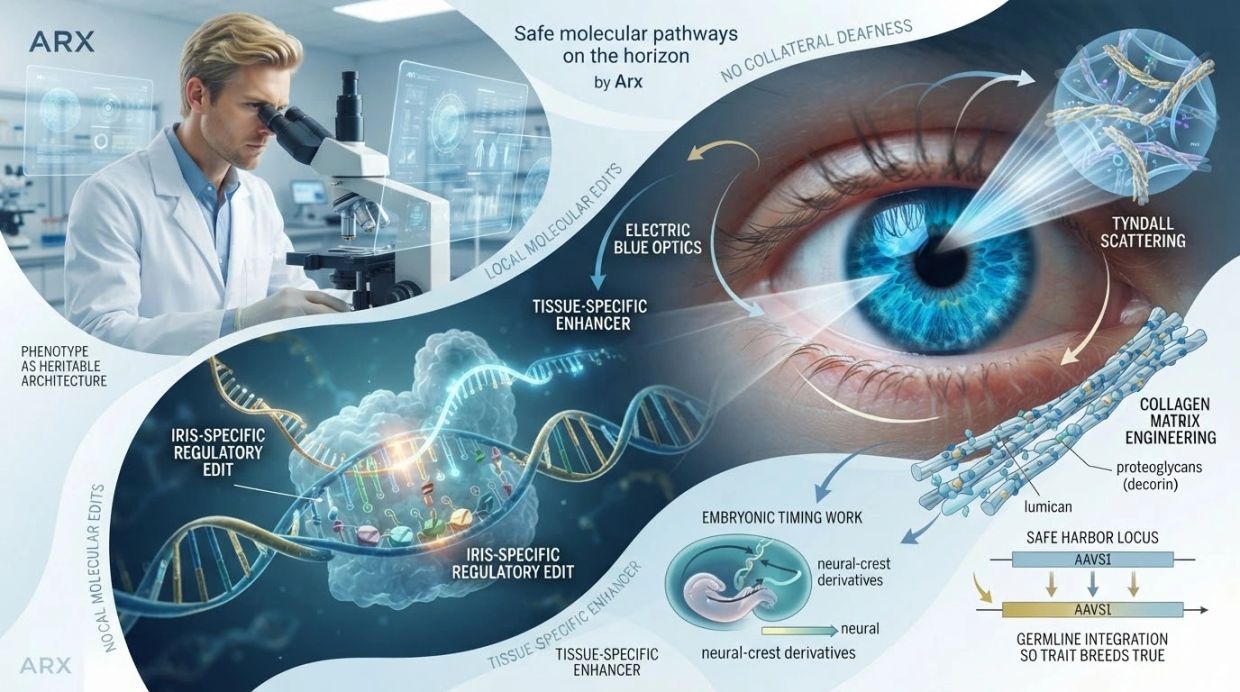
Reproductive biology and the foundry. Gamete-quality assays. Age-related aneuploidy. Fertilization, implantation, and live-birth rates by protocol. Empirical limits of pre-implantation genetic testing, including what a test can and cannot call. Gamete-bank viability over storage time. Health baselines in parents and offspring. Regulatory classification of horizons such as CRISPR, germline rewriting, and cloning. Unvalidated interventions are studied as methods. They are not deployed.
Developmental science. Sensitive periods. Caregiver co-regulation as a physiological measure. Gene–environment interaction and epigenetic marks tied to early care. The cost of attempting to overwrite an early baseline. Longitudinal designs that separate inherited architecture from later training. Formation methods are applications of these findings, not substitutes for them.
Neuroendocrinology and well-being measurement. Oxytocin and vasopressin assays. Pair-bond stability. Status and competence physiology. Sleep, circadian disruption, and light exposure inside a habitat. Links between these measures and trust, mating stability, and group cohesion. The claim is only as strong as the assay.
Comparative domestication genetics. Selection histories in cattle, horses, dogs, and crops as the existing evidence base for multi-generation conscious selection. Inbreeding depression, correlated response, and loss of variation under managed breeding. Restoration cases, including rare breeds and aurochs-type stock, as field tests of the same methods.
Closed-population epidemiology and habitat health. Transmission dynamics, founder effects, and surveillance in semi-closed groups. Clinical formularies, trauma, infection, and aging trajectories. Guest exposure as an epidemiological variable. Longitudinal health data fed back into the genetic record.
Governance models and methods. Comparative tests of constitutions, title structures, dual ledgers for competence and gametic merit, screening protocols, and institutional memory. Outcome measures include trust decay, defection, replication fidelity, and whether a rule still functions after the founders leave. Charters and doctrines are inputs to the test, not results of it.
Settlement, siting, and built environment. Arcology prototypes, fortified and biophilic envelopes, Dunbar-scaled and holonic layouts, hospitality plants, municipal substrates, geotechnics, wildfire behavior, watersheds, and blueprint replication. Research question: which physical forms keep a selection and health program measurable.
Closed-loop engineering. On-site energy, including solar, wind, geothermal, and small modular reactors. Water and atmospheric reclamation. Waste-to-compost systems. Repairable materials, tool non-dependency, and maintenance robotics. A loop counts as closed only when the mass and energy balance is measured.
Security and records. Physical perimeters. Quantum-resistant encryption for genetic and cultural records. Cryptographic identity. Digital hard-shell controls. The research object is record integrity and failure under intrusion, not a police model.
Agriculture and ecology. Closed-loop food yield, vertical farming, soil and orchard health, seed and cold storage, and localized veterinary care. Domestication trials run against the genetics program above.
Sociology and demography. Mating-market imbalance as a supply measurement: scarcity of high genetic quality relative to demand. Fertility, shift design, alloparenting load, and labor-caste formation. Academy recruitment tested as a selection engine against competence and gametic ledgers.
Culture and transmission. What ritual, craft, music, and handbook text actually carry across generations, measured by retention and behavior, not by authorship. Historical and Nordic reference cultures used as design inputs where the functional claim can be checked.
Capital and external relations. Open-source financial instruments, resource-backed accounts, and bans on resident landlordism tested for effects on residency, defection, and node replication. Diplomatic models with host counties and nations tested for permit survival and legal exposure.
Knowledge systems. Secure site architecture. AI restricted to drafting under operator review, with error rates logged. Terrestrial nodes instrumented as ground analogs.
Off-world and closed-habitat engineering. Air, water, and waste balances. Confinement psychology and crew selection metrics. Radiation shielding, partial-gravity adaptation, and off-Earth reproduction as developmental and genetic problems. No protocol leaves Earth trial until the terrestrial measurement holds.
Each node is instrumented as a foundry for conscious human evolution. Through these domains, Arx research and development treats each node as an instrumented foundry for conscious human evolution. Genetic prediction, reproductive outcome, developmental baseline, health, trust, and closed-loop performance are measured in the same population across generations. A method is retained when the predicted change appears in offspring and the habitat still functions. Architecture, governance models, and off-world analogs are kept insofar as they make that measurement possible.