Arx: Conscious human evolution for multigenerational ascent through voluntary order.

Arx Revolution

Arx RevolutionArx RevolutionArx Revolution
Home
Vision
Defining the Revolution
Arx as Incubator
Foundational Principles
Why Lineage?
About
Conscious Evolution
Trait Amplification
Beauty as North Star
Genetic Concepts
Horizon Genetics
Spirituality and God
Arx Architecture
Sociological Architecture
Life Cycle and Formation
Psychology/Neurobiology
Structured Daily Order
Operational Framework
Federation Organization
Local Organization
Revitalizing Small Towns
Culture
Arx as Hospital
Natural Conception/ART
Humanoid Robots in Arx
Who Is Arx for?
How an Arx Pays
Join Us
FAQ
Privacy Policy

Arx Revolution

Arx RevolutionArx RevolutionArx Revolution
Home
Vision
Defining the Revolution
Arx as Incubator
Foundational Principles
Why Lineage?
About
Conscious Evolution
Trait Amplification
Beauty as North Star
Genetic Concepts
Horizon Genetics
Spirituality and God
Arx Architecture
Sociological Architecture
Life Cycle and Formation
Psychology/Neurobiology
Structured Daily Order
Operational Framework
Federation Organization
Local Organization
Revitalizing Small Towns
Culture
Arx as Hospital
Natural Conception/ART
Humanoid Robots in Arx
Who Is Arx for?
How an Arx Pays
Join Us
FAQ
Privacy Policy
More
  • Home
  • Vision
  • Defining the Revolution
  • Arx as Incubator
  • Foundational Principles
  • Why Lineage?
  • About
  • Conscious Evolution
  • Trait Amplification
  • Beauty as North Star
  • Genetic Concepts
  • Horizon Genetics
  • Spirituality and God
  • Arx Architecture
  • Sociological Architecture
  • Life Cycle and Formation
  • Psychology/Neurobiology
  • Structured Daily Order
  • Operational Framework
  • Federation Organization
  • Local Organization
  • Revitalizing Small Towns
  • Culture
  • Arx as Hospital
  • Natural Conception/ART
  • Humanoid Robots in Arx
  • Who Is Arx for?
  • How an Arx Pays
  • Join Us
  • FAQ
  • Privacy Policy

  • Home
  • Vision
  • Defining the Revolution
  • Arx as Incubator
  • Foundational Principles
  • Why Lineage?
  • About
  • Conscious Evolution
  • Trait Amplification
  • Beauty as North Star
  • Genetic Concepts
  • Horizon Genetics
  • Spirituality and God
  • Arx Architecture
  • Sociological Architecture
  • Life Cycle and Formation
  • Psychology/Neurobiology
  • Structured Daily Order
  • Operational Framework
  • Federation Organization
  • Local Organization
  • Revitalizing Small Towns
  • Culture
  • Arx as Hospital
  • Natural Conception/ART
  • Humanoid Robots in Arx
  • Who Is Arx for?
  • How an Arx Pays
  • Join Us
  • FAQ
  • Privacy Policy

Neurochemical Optimization in the Arx

Diagram of neurochemical optimization in the brain's Arx.

Neurochemical Optimization in the Arx

Neurochemical Optimization in the Arx

Engineering the biological substrate of conscious evolution

Human excellence is not an abstraction. It is expressed through the precise orchestration of neurochemicals — dopamine, serotonin, oxytocin, vasopressin, GABA, glutamate, endorphins, norepinephrine, acetylcholine, and the broader suite of transmitters, modulators, peptides, and neurosteroids that govern motivation, bonding, resilience, cognition, hierarchical cooperation, and adaptive capacity.

Modern environments systematically dysregulate this system. Ultra-processed food, chronic sleep disruption, fragmented low-trust social bonds, status-ambiguous hierarchies, meaning-deficient culture, sedentary isolation, artificial light, thermal monotony, inflammatory load, and developmental mismatches produce dysregulated reward circuits, blunted or misdirected bonding chemistry, elevated stress signaling, impaired receptor sensitivity, and reduced capacity for high-trust, multi-generational cooperation.


Arx is designed as a corrective foundry. Nutrition and metabolic foundations, sleep architecture, social organization and hierarchy, physical and sensory environment, culture and meaning, developmental calibration, hormonal milieu, and daily practice are deliberately engineered so that the full spectrum of neurochemicals operates in alignment with multi-generational ascent rather than short-term survival or entropy.


Genetic, Developmental & Hormonal Foundations

Baseline neurochemical tone is shaped by genetic variants in synthesis enzymes, transporters, receptors, and degradation pathways (COMT, MAOA, TPH2, SLC6A4, DRD variants, GAD1, and others), by epigenetic programming during critical early windows, and by the shifting hormonal background across the lifespan.

Arx treats these as design variables rather than fixed constraints. Reproductive selection and voluntary advanced technologies aim to amplify adaptive alleles and reduce load from high-risk variants. Structured early environments — consistent high-quality care, alloparenting, and Life Guide systems during sensitive periods — calibrate oxytocin and vasopressin systems, HPA-axis set-points, and later adult reactivity.

Sex steroids, neurosteroids (allopregnanolone and related compounds), thyroid status, insulin sensitivity, and inflammatory tone continuously modulate receptor function and synthesis. The foundry maintains conditions that support favorable hormonal profiles: metabolic health, resistance training, sunlight, and low chronic inflammation. Age- and stage-appropriate support is built into the architecture of daily life.


Nutrition, Gut-Brain Axis & Metabolic Substrate

Closed-loop agri-systems deliver high-quality protein, fat, and micronutrient density that supply the amino-acid precursors and cofactors required for synthesis: tyrosine and phenylalanine for dopamine and catecholamines; tryptophan for serotonin; choline for acetylcholine; B-vitamins, zinc, iron, magnesium, and omega-3 fatty acids for enzymatic function and membrane integrity.

Stable blood glucose, controlled insulin dynamics, and minimal inflammatory load protect GABA/glutamate balance and reduce chronic cortisol interference. The gut-brain axis is treated as critical infrastructure. Fermented foods, diverse fiber, and microbial diversity support peripheral serotonin production, short-chain fatty acid signaling, and vagal tone that influence central neurochemistry. Circadian-aligned eating windows reinforce the clocks that gate release and receptor sensitivity.

Avoidance of industrial toxins, endocrine disruptors, and ultra-processed inputs further protects the hormonal-neurochemical interface. The result is reliable substrate for motivation, mood stability, cognitive clarity, and stress resilience rather than the volatile spikes, crashes, and low-grade inflammation of the industrial diet.


Sleep Architecture & Circadian Alignment

Deep, high-quality sleep is non-negotiable recovery. Overnight, dopamine receptors are restored, serotonin and melatonin pathways recalibrate, synaptic pruning and memory consolidation occur under balanced GABA and glutamate signaling, and the glymphatic system clears metabolic waste that impairs receptor function.

Arx environments enforce dark, cool, quiet sleep spaces, morning full-spectrum light exposure, and rigorous protection from artificial light at night. Structured daily rhythms — work, training, communal meals, evening wind-down — entrain the master clocks that govern neurotransmitter synthesis, release, and receptor expression. Chronic sleep debt is engineered out as a systems failure.


Social Organization, Hierarchy, Bonding & Mating Dynamics

Oxytocin and vasopressin are the primary chemistry of trust, selective loyalty, pair-bonding, parental investment, and protective territoriality. High-trust, bounded communities with clear membership, shared purpose, and repeated face-to-face interaction create the conditions for optimal function: physical proximity, eye contact, cooperative effort, and reliable reciprocity.

Clear, earned hierarchies of competence regulate serotonin and dopamine in ways that low-trust or status-ambiguous environments cannot. Rank is tied to contribution and alignment rather than manipulation or extraction. Structured alloparenting and Life Guide systems extend caregiving while preserving primary attachment, activating oxytocin pathways in both children and caregivers and transmitting prosocial capacity across generations.

Pair-bonding quality, sexual culture within high-trust bounds, and intimate touch further engage oxytocin, prolactin, endorphins, and dopamine in patterns that reinforce long-term investment rather than transient novelty. Fragmented, low-trust, or transient social forms suppress or misdirect these systems; Arx cultivates the opposite.


Culture, Ritual, Agency, Achievement & Contemplative Practice

Healthy dopamine signaling is driven by progress toward valued goals, mastery, flow states, and contribution — not endless novelty or passive consumption. Meritocratic structures, tangible collective projects (building, breeding, knowledge transmission, defense of the foundry), and calibrated challenge provide repeated, earned reward.

Serotonin is elevated by sunlight, earned status within a coherent group, perceived agency and self-efficacy, and the felt sense of belonging to a lineage and purpose larger than the individual. Ritual, beauty as north star, shared festivals, and contemplative practices stabilize mood, reduce amygdala reactivity, and reinforce group coherence. Endorphins and related opioids are recruited through physical training, communal effort, mild controlled stressors, and the antifragile challenges that build resilience.

Culture is the software that keeps reward, affiliation, hierarchical, and stress systems calibrated to long-horizon excellence.


Physical Environment, Sensory Inputs, Thermal Stress & Movement

Biophilic architecture, extensive greenspace, natural light spectra, clean air, and acoustic design restore ancestral sensory inputs that regulate serotonin, dopamine, and cortisol. Nature-specific elements — biodiversity exposure, phytoncides, soil contact — further support these pathways.

Thermal variation and deliberate cold exposure elevate catecholamines and dopamine; movement is the default rather than an add-on. Strength, skill, and endurance training raise catecholamines, endorphins, and BDNF while improving insulin sensitivity and sleep quality. Breathing practices and oxygenation support autonomic balance and GABA tone.

The arcology itself is engineered to minimize chronic toxin load, noise pollution, and sensory monotony while maximizing the inputs that keep the neurochemical system robust.


Integrated Effect

These domains form a closed reinforcing loop. Genetic and developmental foundations set the range and calibration. Nutrition, gut integrity, and hormonal milieu supply the substrate. Sleep restores receptor function and clearance. High-trust hierarchy, bonding, and mating dynamics saturate oxytocin/vasopressin and regulate serotonin/dopamine. Culture, agency, and achievement channel those pathways toward lineage-level outcomes. The physical, sensory, and thermal environment continuously modulates the entire system.

The outcome is individuals and cohorts with elevated capacity for sustained agency, selective loyalty, hierarchical cooperation, cognitive clarity, and intergenerational investment — the neurochemical profile required for conscious evolution inside sovereign foundries.


Arx does not chase transient “happiness chemicals.” It engineers the conditions under which the full suite of neurochemicals serves adaptive excellence across lifetimes and lineages.


Vasopressin and Male Bonding

Vasopressin, Male Bonding, and the Modern Crisis — and How Arx Restores Vasopressin

Vasopressin, Male Bonding, and the Modern Crisis — and How Arx Restores Vasopressin

Vasopressin (arginine vasopressin, AVP) is a neuropeptide and hormone that plays a distinct and powerful role in male social behavior. While oxytocin is often popularly associated with bonding in general, vasopressin is more strongly linked in males to territorial defense, selective affiliation, pair-bond maintenance, and the formation of durable same-sex alliances. In the brain it acts primarily through V1a receptors in regions of the limbic system, influencing aggression thresholds, stress regulation, and the neural encoding of “who belongs with me.” 


Classic prairie-vole research demonstrated that variation in V1a receptor distribution can shift males from promiscuous to strongly monogamous and group-oriented strategies; parallel findings in humans associate vasopressin pathways with protective loyalty, in-group preference, and the willingness to invest in long-term cooperative relationships.


Modern Western environments systematically under-stimulate these pathways. Traditional male institutions that once reliably triggered vasopressin release—shared physical labor, hierarchical apprenticeships, martial or athletic brotherhoods, all-male rites of passage, and regular face-to-face gatherings of known peers—have contracted or been culturally devalued. Concurrently, rising rates of social isolation, screen-mediated interaction, delayed or absent pair-bonding, and the near-disappearance of low-stakes physical camaraderie have left many men with fewer opportunities for the repeated, embodied signaling that keeps the vasopressin system robust. The result is not merely loneliness statistics; it is a functional under-activation of a neurochemical system that evolved to stabilize male coalitions and kin-like loyalty. This can be described as a quiet vasopressin deficit: weaker spontaneous trust among men, higher baseline social anxiety in male groups, reduced willingness to form and defend durable alliances, and a corresponding rise in atomized, low-commitment social patterns.


Arx arcologies are deliberately engineered to reverse this deficit. They restore the environmental conditions that historically activated male vasopressin circuits while embedding those conditions inside a coherent cultural and genetic framework. Physical proximity is rebuilt through Kinship Circles, Mentor Clans, and larger Bands whose sizes track known human social layers. Ritual warrior training, sauna gatherings, and shared labor—supplies the repeated, multi-sensory cues (touch, synchronized movement, collective affirmation, mild physiological stress followed by resolution) that elevate vasopressin signaling. Hierarchical yet voluntary structures give the territorial and protective aspects of the system legitimate outlets rather than leaving them frustrated or pathologized. 


In short, Arx does not merely “encourage male friendship”; it reconstructs the ecological niche in which male vasopressin-mediated bonding can function at full strength, converting an atomized deficit into dense, high-trust kinship.


This restoration is not therapeutic in the modern clinical sense. It is architectural and cultural: the built forms and daily rhythms are calibrated to keep the relevant neural and hormonal systems engaged across the lifespan. The outcome is not simply happier individuals but more coherent, higher-trust male networks capable of the long-term cooperation that large-scale intentional communities require.

Oxytocin and Female Bonding

Oxytocin, Female Bonding, and the Modern Crisis — and How Arx Restores It

Oxytocin, Female Bonding, and the Modern Crisis — and How Arx Restores Oxytocin

Oxytocin is the primary neuropeptide shaping female social bonding. Where vasopressin more strongly organizes male territoriality, selective aggression, and coalition defense, oxytocin governs attachment, nurturing motivation, emotional attunement, and the dense, continuous relational networks that historically sustained women and children.


It rises sharply during birth, lactation, and close physical contact. It heightens the salience of familiar faces, lowers defensive barriers toward trusted others, and reinforces the motivation to care for the young and the vulnerable. In monogamous species it is essential for female partner preference; in humans it underpins mother–infant bonding and the broader capacity for alloparental investment. The system is highly sensitive to repeated, embodied cues: skin-to-skin contact, synchronized caregiving, vocal reassurance, and the presence of known women sharing the work of raising children.


Contemporary life systematically starves this system. The multi-generational households and dense female mutual-aid networks that once provided continuous low-level oxytocin stimulation have largely dissolved. Motherhood is delayed or deferred, leaving many women without the powerful physiological resets of pregnancy, birth, and nursing during their peak reproductive years. Child-rearing has been privatized into isolated nuclear units or professionalized into institutions. Face-to-face female gatherings centered on shared labor and shared children have been replaced by fragmented digital contact and competitive peer environments. The result is not simply loneliness. It is a functional under-activation and dysregulation of a bonding system evolved for continuous, high-contact relatedness. Many women experience this as chronic social anxiety, difficulty sustaining deep trust with other women, reduced spontaneous caregiving motivation, and a persistent sense of relational scarcity even when surrounded by people.


Arx is designed to reverse these conditions. Kinship Circles and Mentor Clans restore daily physical proximity among known women. Structured alloparenting and the Life Guide system distribute the care of children across trusted adults rather than concentrating it on a single exhausted mother. Shared work, collective child-rearing spaces, and regular embodied gatherings reintroduce the multi-sensory cues—touch, co-presence, synchronized care, and mutual affirmation—that keep oxytocin pathways engaged. Hierarchical yet voluntary female roles give the nurturing and protective dimensions of the system clear status and legitimacy instead of leaving them undervalued or pathologized.


This is not a therapeutic intervention aimed at individual symptoms. It is an architectural and cultural redesign of the female social environment. By reconstructing the conditions under which oxytocin evolved to function, Arx converts fragmented, low-trust female experience into dense, high-trust networks capable of sustained cooperative child-rearing and cultural transmission across generations.

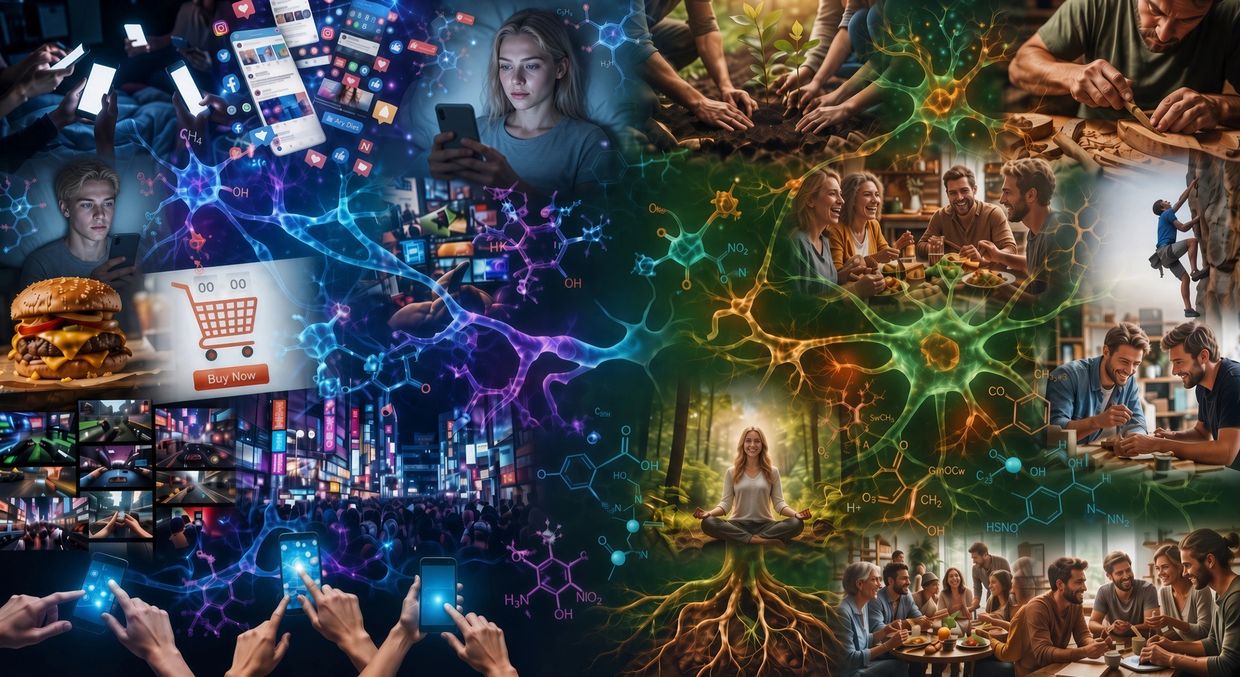
How the Modern World Hijacks Dopamine Circuits

How the Modern World Hijacks Dopamine Circuits

How the Modern World Hijacks Dopamine Circuits

For tens of thousands of years, dopamine was our evolutionary engine. It was the neurochemical reward for tracking prey, forging community, solving complex problems, and enduring hardship for long-term survival. Dopamine’s core job is not pleasure — it is motivation. It drives us to seek, focus, and pursue. Pleasure itself is handled more by other systems.

Today that ancient survival mechanism has been weaponized against us.

Modern civilization did not merely overstimulate dopamine — it re-engineered it. The world now systematically hijacks the brain’s reward pathways in ways no ancestral nervous system was built to withstand. This is not primarily a moral failing. It is a structural mismatch between ancient neurobiology and hyper-stimulating environments.


The Hijackers

1. Infinite Novelty Streams

Social feeds, notifications, and algorithmic content deliver endless micro-novelties. The brain evolved for scarce novelty; now it is drowning in it. Result: chronic distraction, fractured attention, and weakened long-term motivation.

2. Hyper-Palatable Food Engineering

Industrial food is optimized for maximum dopamine per bite. Salt–fat–sugar ratios are tuned to bypass natural satiety signals. Result: compulsive eating, metabolic dysfunction, and reward-system desensitization.

3. Digital Social Validation Loops

Likes, comments, and follower counts create synthetic social hierarchies. The brain treats these signals as real status cues. Result: anxiety, comparison addiction, and fragile self-worth.

4. On-Demand Entertainment

Streaming, gaming, and short-form video provide instant emotional regulation. No effort, no friction, no challenge. Result: reduced tolerance for boredom and diminished drive for meaningful effort.

5. Consumer Dopamine Traps

Shopping platforms weaponize scarcity, countdown timers, and “limited drops.” Purchases become micro-hits rather than functional decisions. Result: compulsive consumption and identity built around acquisition.

6. Workplace Gamification

Metrics, dashboards, and productivity apps create dopamine-based compliance systems. Workers chase numbers instead of mastery. Result: burnout, shallow work, and loss of intrinsic motivation.

7. Fragmented Life Rhythms

Constant interruptions break natural cycles of focus, rest, and recovery. The brain never completes a full reward arc. Result: chronic dissatisfaction and perpetual low-grade craving.

8. Synthetic Sexual Stimulation

Pornography and digital intimacy provide supernormal stimuli far beyond ancestral norms. The reward system becomes conditioned to unrealistic novelty and zero-effort intensity. Result: intimacy distortion and reduced capacity for real-world bonding.

Arx targets this synthetic, frictionless form of sexual stimulation. Embodied encounters that carry no expectation of a lasting attachment remain compatible with the culture. Such encounters can create memory and transient neurochemical effects, but they do not by themselves form the selective, sustained bonds mediated by oxytocin and vasopressin. The distinction matters: Arx rejects digital sexual extraction while remaining open to real, face-to-face contact that does not import low-trust, high-novelty patterns.

9. Urban Overstimulation

Noise, lights, crowds, and advertisements bombard sensory pathways. The brain stays in a low-level “reward-alert” mode. Result: fatigue, irritability, and dopamine depletion.

10. Loss of Natural Achievement Cycles

Modern life removes the slow, effortful, meaningful challenges humans evolved to pursue. Without these cycles, dopamine has no constructive outlet. Result: existential drift and the feeling of being “stuck.”


How Arx Is Different

Arx does not fight dopamine — it reclaims and upgrades it. We do not remove novelty, intensity, or stimulation. We improve them.

Arx environments are deliberately high in real novelty, real social intensity, real achievement, and real sensory richness. The difference is that these rewards are grounded in embodiment, competence, lasting bonds, and long-arc purpose rather than engineered for extraction.

•  Designed for Friction and Flow
Arx reintroduces healthy, purposeful friction while preserving high stimulation. True fulfillment lives on the other side of effort, but the effort itself is made deeply rewarding. Challenge → effort → mastery → contribution becomes a living dopamine cycle, not a dry discipline.

•  Real Bonding Chemistry Over Synthetic Hits
Face-to-face, high-trust communities structured around Dunbar-scale layers and clan-like bonds prioritize oxytocin and vasopressin — the peptides of loyalty, protection, and sustained attachment. Social intensity is not reduced; it is deepened. Shared physical presence and mutual obligation generate stronger, more lasting reward than digital validation ever could.

•  Meaningful Achievement Cycles
Life Guides, Offspring development, community roles, and long-term projects create long-arc dopamine loops that build identity, competence, and purpose. Novelty and progress remain constant — they are simply real instead of algorithmic.

•  High-Dopamine, Low-Addiction Pathways
Reward is channeled into mastery, caregiving, creation, community building, physical vitality, and evolutionary contribution. These are high-dopamine pathways that do not desensitize the system the way modern hijacks do.

•  A Culture of Protected Attention and Abundant Stimulation
Attention is treated as a sacred resource, yet the environment itself is rich: biophilic design, embodied activity, intense social life, and continuous real-world novelty. We shield dopamine from exploitation while flooding it with higher-quality inputs.

•  From Consumer to Sovereign Operator
Traditional systems treat people as the product. Arx treats members as sovereign operators who redirect energy from reactive consumption into deep, self-directed creation — and enjoy the intensity of that creation.


Arx keeps what is good in the modern world — novelty, stimulation, social reward, achievement highs — and makes them better: more embodied, more relational, more durable, and more aligned with human nature.


You do not need a new brain. You need to reclaim the one that is being rented from you — and put its power somewhere better.

Welcome to Arx.

Copyright © 2026 Arx Revolution - All Rights Reserved.

Powered by

  • Privacy Policy

This website uses cookies.

We use cookies to analyze website traffic and optimize your website experience. By accepting our use of cookies, your data will be aggregated with all other user data.

DeclineAccept